| September 2025 – Canada’s immigration policy continues to move in the wrong direction and requires a fundamental course correction, according to a new Communiqué from the C.D. Howe Institute’s Immigration Targets Council. In “Immigration Policy Still in Need of a Course Correction,” the Council – composed of leading academics and policy experts – stresses that who is selected matters more than meeting numeric targets. They determined that immigration should be guided by human capital and long-term prosperity, not short-term labour market fixes or non-economic objectives. Notably, members also emphasized the importance of transparent, predictable policy that ensures economic immigrants have strong skills, earnings potential, and integration prospects. |
Second Meeting of the C.D. Howe Institute Immigration Targets Council
The C.D. Howe Institute Immigration Targets Council held its second meeting on August 26, 2025, bringing together leading academics and policy experts to provide recommendations on Canada’s immigration-level targets and system design.1
Members agreed that Canada’s immigration policy has moved in the wrong direction and needs a fundamental course correction. Members stressed that the labour market skills and earnings potential of immigrants – both temporary and permanent – matter more than meeting numeric targets. Immigration policy should raise average human capital, rather than focusing narrowly on filling short-term labour market gaps, which prevents wage increases and capital investment to enhance productivity, or meeting non-economic objectives such as increasing Francophone immigration outside Quebec. Policy should also be transparent, predictable, and oriented toward long-term prosperity, ensuring that economic immigrants have strong skills, earnings potential, and integration prospects.
Building on these principles, the Council recommended annual permanent resident admissions of 365,000 in 2026, 360,000 in 2027, and 350,000 in 2028, reflecting the Council’s median votes. For 2026, this recommendation is modestly below the government’s current target of 380,000. Some members favoured a gradual reduction over three years to return to historical norms, while others supported higher levels to ease transitions from the non-permanent resident (NPR) population.
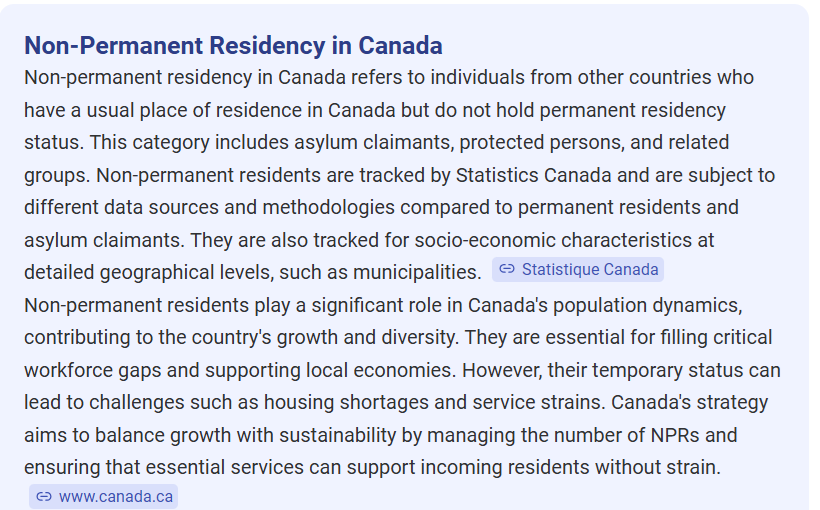
The group also raised serious concerns about the rapid growth and complexity of the NPR (Non permanent residency) population, as well as persistent challenges in the asylum system.
Members emphasized the importance of clear guardrails for the NPR population, recommending that the government maintain a ceiling of 5 percent of Canada’s population for NPRs in 2026, with a review in early 2027. They noted that the optimal NPR share requires balancing inflows, outflows, and clear pathways for temporary residents employed in high-skill occupations to transition to permanent residency, using objective criteria such as earnings. Improving efficiency in the asylum system was viewed as critical to protect genuine claimants and reduce pressures on the broader immigration system, since many currently see asylum as a pathway to permanent residency.
The Council further agreed that immigration programs require substantial reforms.
Regarding temporary immigration, members expressed concern that the international student system has become a pathway for low-wage labour rather than a means of attracting top global talent. They recommended higher admission standards, stronger language and academic requirements, limits on off-campus work, and stronger federal oversight to ensure only high-quality institutions and programs are eligible. Similarly, the Temporary Foreign Worker Program should be scaled back and not be used as a substitute for raising wages or improving working conditions, since relying on temporary workers can reduce employers’ incentives to offer better pay or workplace standards. Reducing reliance on low-skilled temporary workers – except in sectors such as agriculture, where transitions take time – was viewed by the group as essential to encourage productivity growth and higher wages for Canadian workers.
For permanent immigration, members were critical of the proliferation of boutique pathways in the economic class, such as category-based selection – targeted draws from the Express Entry pool based on specific attributes like occupation or language – and provincial nominee programs that prioritize lower-skilled workers, which allow provinces and territories to nominate candidates to meet regional labour market needs. They highlighted the need to simplify and strengthen the selection mechanism and agreed that Canada should move toward a single, transparent system centred on Express Entry and the Comprehensive Ranking System (CRS), a points-based tool used to assess, score, and rank candidates in the pool. They supported a human-capital-based model for economic principal applicants, which evaluates individuals on their education, work experience, and language ability, with a revised CRS that places greater weight on predictors of long-term success. New criteria should include the field of study for all applicants and verified earnings in Canada for those with prior Canadian experience. All economic principal applicants, they stressed, should be required to meet the CRS threshold. Members also agreed that these reforms – across temporary and permanent immigration programs, together with improving the integrity of the asylum system – are essential to reducing the size of the non-permanent resident population.
In addition, members highlighted the importance of fast-track pathways and policies to attract top-tier global talent. They called for stronger federal–provincial coordination and targeted initiatives to recruit individuals with extraordinary achievements in fields with lasting impact, such as science, medicine, and artificial intelligence. For high-profile research leaders, this should include pathways that allow them to bring their teams. Attracting such talent, they noted, requires not only immigration pathways but also the infrastructure and support that world-class research demands.
In conclusion, the Council emphasized the urgent need to restore a principled and sustainable immigration policy. By focusing on raising human capital, maintaining guardrails on the non-permanent resident population, addressing weaknesses in the asylum system, and reforming the economic immigration system, Canada can ensure that immigration contributes to long-term prosperity and sustains public confidence.
Members of the C.D. Howe Institute Immigration Targets Council:
Members participate in their personal capacities, and the views collectively expressed do not represent those of any individual, institution, or client.
Convener:
• Parisa Mahboubi, C.D. Howe Institute
Members:
• Don Drummond, Queen’s University
• Pierre Fortin, Université du Québec à Montréal
• David Green, University of British Columbia
• Daniel Hiebert, University of British Columbia
• Michael Haan, Western University
• Jason Kenney, Bennett Jones LLP
• Mikal Skuterud, University of Waterloo
• Christopher Worswick, Carleton University
• Donald Wright, C.D. Howe Institute and Global Public Affairs