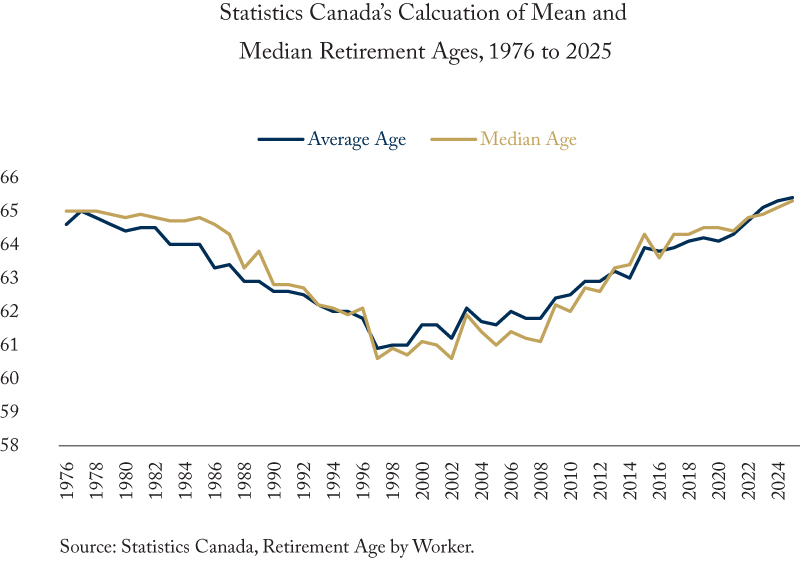
Statistics Canada’s retirement-age data tell a remarkable story.
After declining steadily from about age 65 in the late 1970s to roughly 61 around 2000, the average retirement age has climbed back to historically high levels (see Figure).
In 2025, the average retirement age reached 65.4 years overall – 66.2 for men and 64.5 for women.
The reversal reflects the interaction of several long-term forces affecting both the supply and demand for older workers.
On the supply side, one of the most important structural changes has been the maturation of women’s participation in the labour market. Compared with earlier generations, today’s older women have much stronger lifetime attachment to paid work, higher pension entitlements, and retirement decisions that are increasingly coordinated with those of their spouses. This transformation has fundamentally reshaped aggregate retirement behaviour.
Demographic trends reinforce this shift. Slower labour force growth resulting from population aging, lower fertility, and recent reductions in immigration have tightened labour supply. As fewer younger workers enter the labour market, employers increasingly rely on experienced older workers to fill skill shortages.
Demand has evolved as well.
Canada’s economy has continued its transition toward service, professional and knowledge-based employment, where accumulated skills and experience often become more valuable with age and where many occupations are less physically demanding than in previous decades.
Longer and healthier lives have also changed retirement behaviour. Many Canadians reaching their mid-sixties today can expect another two or three decades of life, much of it in good health. Retirement has increasingly become a gradual transition rather than a single event, with combinations of continued career employment, part-time work, consulting, self-employment and phased retirement becoming more common.
Changes in social attitudes have contributed.
The elimination of mandatory retirement removed barriers for those wishing to remain employed, while employers and governments have become more attentive to age discrimination. Although the abolition of mandatory retirement appears to have had only a modest direct statistical effect on retirement ages, it expanded opportunities for those who wished to continue working.
These developments have now reached an important milestone. Among Canadians aged 65 and over – the traditional age of public pension eligibility – the proportion continuing to work has grown steadily and is likely to continue increasing.
This evolution suggests that Canada’s retirement income system deserves a fresh review. Much of its architecture was designed when retirement was relatively brief, labour force participation after age 65 was uncommon, and workplace pension coverage was both broader and more generous.
The increase in retirement ages is therefore more than a demographic curiosity. It signals that Canadians have already adapted their behaviour to longer lives, changing labour markets and evolving retirement patterns. Public policy should now consider whether the retirement income system has adapted as well.
Retirement is increasingly diverse. Some Canadians work longer because they choose to remain engaged; others because financial necessity leaves little alternative.
At the same time, important features of the current system discourage continued work among lower-income seniors through Guaranteed Income Supplement earnings rules, while public pension benefits increasingly flow to many higher-income Canadians who remain economically active well beyond traditional retirement ages.
For the Silo, John Stapleton/ Peter Hicks/ C.D. Howe Institute.
Peter Hicks is a policy adviser and a former Assistant Deputy Minister with Social Development Canada and John Stapleton is the new Social Policy, Ageing and Well-being Policy Fellow at the National Institute on Ageing. He is principal at his consultancy: Open Policy.