Tag Archives: art

Politics in The Arts- Are Canadians Concerned With Art Funding?

During the Federal elections [circa 2011 Ed], it became clear that the Canadian public interest in an arts and cultural policy had declined since 2008, in fact the majority responded that this policy was unimportant to them in comparison to other policies. This leads me to question the degree of concerns Canadians do have with other policies. Perhaps the overall concerns are too great to allow a focus on more fun or abstract facets of their Canadian lifestyle such as arts and culture, or it may simply be that Canadians overall would rather engage with more mainstream topics.

It is interesting yet disconcerting to see that it is mainly the younger population, ages 18-30, that are the least interested in the arts and culture policy. If the younger generation doesn’t fuel the arts and keep them flourishing who will? In their (or our) defense though, little awareness about the policy and its impact is made known. Personally, I had never heard of an arts and cultural policy before reading the article critiquing the different Government parties’ role in the policy as discussed in The Arts Advocate publication.

The policy involves the government allotted a specific percentage of taxes that go towards varying sectors within the arts, for example advantages for artists or funding for different organizations. Each federal party has their different views on appropriate expenditure in the arts and culture sector, and specifically our Conservatives’ main commitment is to the children’s artistic activity tax credit, support to the Royal Conservatory of Music for a national examination program, and support to the Canadian Periodical Fund (Used to subsidize newspapers not including The Silo. Check the info box found on the bottom of page 2 in most papers to see if you are subsidizing their bottom line- CP).

With the Conservative party now being back in power, it is hard to say if the policy will see any positive growth. Although I understand and admire Harper’s plan to stabilize and improve the markets in the depths of a global recession, I feel it necessary to include arts and culture as a part of this. Canada has such a unique combination of cultures throughout its provinces and these are the people who create and work at the jobs Harper is trying to develop or advance.

So, should not this rich arts and culture naturally be showcased as it is echoed throughout the Canadian business world Harper is focused on? I believe Canadians on the whole would appreciate more recognition for their creative efforts that make our country special. Yes we need economic growth, but there needs to be a balance in the funding between businesses and the arts in order to make for a balanced country and to account for or showcase the people who inhabit it.

It is positive to note that the 2011 Ontario budget indicated spending at Tourism and Culture would grow $76 million.

The estimates confirm that $47 million of this is to continue support of the Community Cultural Fund (used to support local ‘big crowd’ draws such as last year’s Port Dover Marine Festival- http://www.ocaf.on.ca/en/project.aspx?ProjectUID=985 or 2005’s Norfolk County Fall Festival- http://www.ocaf.on.ca/en/project.aspx?ProjectUID=884 -CP), the small-scale (!) capital program administered by the Ontario Trillium Foundation to support diverse cultural organizations. As well, the Ontario Media Development Corporation will be permanently funded, showcasing the province’s commitment to the film sector of the policy and estimates show an increase of $8 million to $25.8 million. Although the Conservative platform for the policy is the most bleak of the Bloc Quebecois, Liberal, and NDP, perhaps a strengthened economy will help to account for areas our country’s arts and culture are struggling in.

In their platform it is stated that our “Government believes that a vibrant cultural, media, and sporting sector is crucial for our well-being and quality of life,” however many artists and cultural advocates still feel that the re-elected Conservatives will fall short in fulfilling the essential aspects of the policy and hearing the voices of those affected.  For the Silo, Jennifer Waslowski.


Machinarium Videogame Combines Art And Visual Storytelling

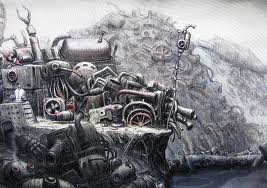
Machinarium is not a new videogame. But if, like many gamers, you overlooked it when it was released in late 2009, you owe it to yourself to go back and pay it some attention. Machinarium may look simple or perhaps even a touch primitive at first glance, but in reality the game is an inspirational fairy tale set in a wondrous, grimy world of living machines; a touching story of struggle, heroism and robot-love.

One of Machinarium’s most remarkable qualities is the way its tale is woven without a single word—there’s not one instance of speech or text in the entire game. Instead, everything is told visually. Dialog between characters unfolds as brief animations, while plot details are filled in through flashbacks.

Even the physical appearances of the game’s denizens, from the diminutive main character to his ruffian tormentors and the strutting, tin-pot police who, in theory at least, guard over the city, figure prominently in the storytelling process, as the pint-sized underdog struggles against bullies and thugs to be the hero his doe-eyed beloved has always believed him to be.

That may be a lot to read into a game that, bizarre setting aside, is a fairly straightforward point-and-click adventure. From a gameplay standpoint, Machinarium is solid if not particularly noteworthy. But the details of its world most definitely are. Each level and everything in it is entirely hand-drawn, providing a unique and whimsical visual style, while the soundtrack, both musical and ambient, is every bit as impressive—possibly more so. The combined effect is nothing short of extraordinary.

Gamers unfamiliar with the standards of “adventure logic,” in which odd, occasionally arbitrary sequences of actions are required to complete tasks and move things forward, may need a little time to get settled, but veterans of the genre will feel right at home. You will collect objects, you will combine objects, and you will use those objects on other objects to make things happen. But the game mechanics are actually quite simple, because everything is visual and its various regions are fairly tightly compartmentalized. Some of the problems you’ll face are real stumpers, however, and while one hint is available for each of the game’s screens, don’t expect it to do much more than give you a very gentle nudge in the right direction.

But that’s okay. Machinarium is a slow-burning experience that’s best savored rather than merely consumed. It crafts gripping beauty out of an ugly world in a way that elevates it from the merely good to the truly memorable. It’s not for everyone: twitchy Halo junkies probably won’t find too much to like in it. But for anyone in the mood for something a little more thoughtful, or who’d just like to see the videogame medium stretch its legs a little bit, Machinarium is a wonderful, magical game that simply should not be missed. For the Silo, Andy Chalk. 


Moon

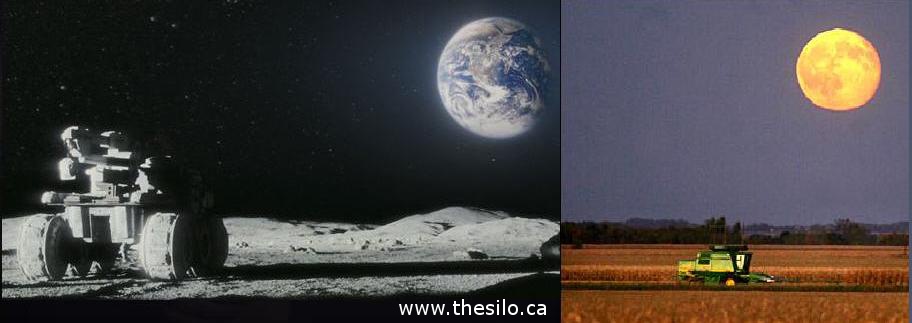
Art imitates rural life.

If you’re like me and grew up on a rich diet of 1980’s science fiction films, you should walk (no make that moonwalk) to your nearest video store and ask for MOON. This little gem is an existential journey into the mind of a lonely farmer-astronaut and hits close to home. Sure there’s the usual high contrast and gritty sci-fi production values, but there are also some poignant connections to our rural habitat. Picture a massive, rambling, white combine harvester gathering hay under a full, late fall moon, except that in this case the moon is the earth. A tiny, lonely man is hunched over the controls in an elevated and sealed cockpit. Now remove all semblance of colour, add a few craters and hills, and you get part of what makes this film so familiar and, dare I say, rural.

Growing up here as a boy I imagined that the once plentiful silos and drive-sheds in Norfolk (especially the aluminum ones) were rocket platforms and moon bases. Even the large, four wheeled crop sprayers had a space age look to them. And that is why I felt especially connected to Duncan Jones’ incredibly moving MOON. It pulled me in and felt familiar.

If I had to bet the farm I’d say the production designer looked at both farms and farm machinery while working out the aesthetics of this movie. But more than that, the story pulls at your heartstrings.

Sam (played by the remarkably versatile Sam Rockwell in a breakthrough role) is a lonely astronaut working on the moon, farming the soil for energy until he begins to suffer from extreme isolation- complete with lucid dreams and hallucinations. What follows next is one of the finest surprise plot twists in contemporary cinema.

Satisfying space fiction from son of iconic rocker David Bowie. For the Silo, Jarrod Barker.