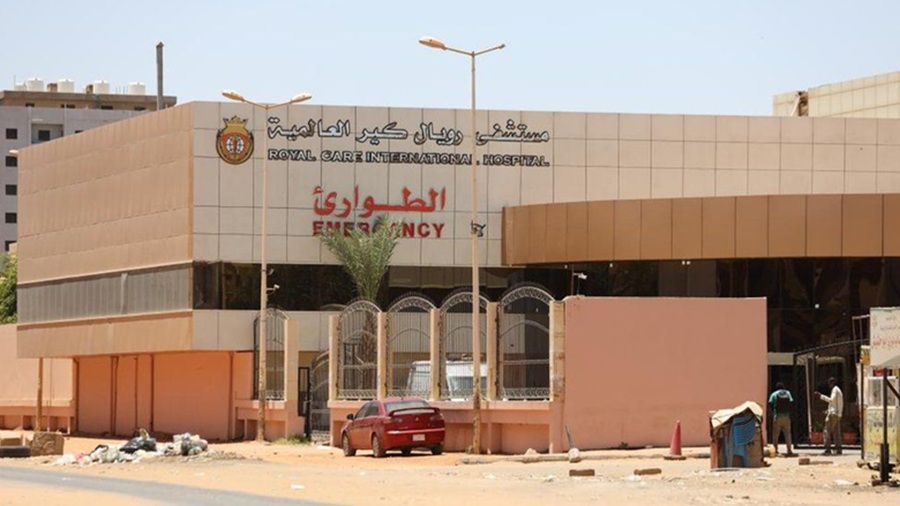
Last week, I travelled to Sudan with two colleagues and six journalists. We went to listen, to learn, and to see more clearly what too much of the world now sees only in fragments. What I came home with was not one neat conclusion, but a deeper conviction that amid one of the gravest humanitarian catastrophes on earth, Sudanese women are still carrying extraordinary burdens with immense courage. More than 30 million people in Sudan are in urgent need of humanitarian assistance, and major humanitarian agencies now describe Sudan as the world’s largest humanitarian crisis.
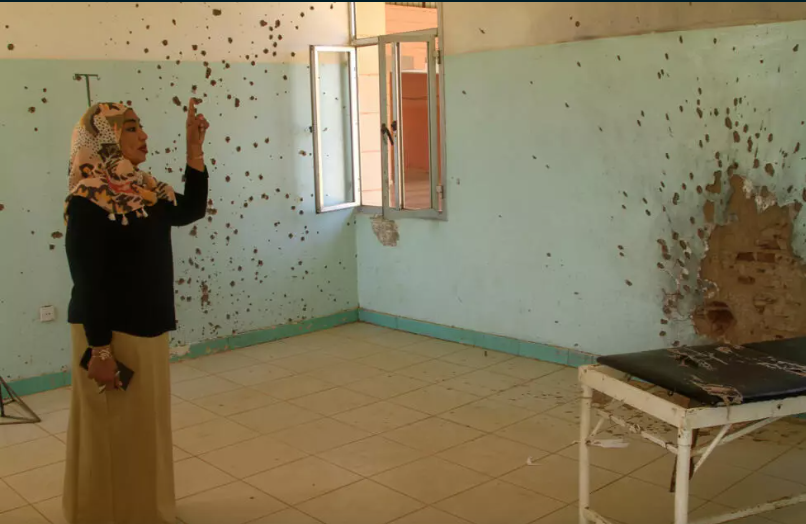
Photo: France24.com Hospital director Dr. Safaa Ali shows the bullet holes that still riddle the wards of the reopened Saudi hospital in Omdurman. © Ebrahim Hamid / AFP
That truth was visible in the wreckage of Khartoum, in the strain of Port Sudan, and in the harsh fragility of the refugee camp near Al Dabbah. But nowhere was it more clear than in the women we met, women who were not simply surviving the war, but, in many ways, still holding Sudan together.
One of the most unforgettable voices of the trip was Dr. Safa Ali, an obstetrician and gynecologist and the director of Saudi Maternity Hospital in Khartoum. She is one of the Sudanese women who have become symbols of moral seriousness in this war, not because they sought attention, but because they refused to leave when everything around them was falling apart. During the war, she stayed at her post even as parts of the city emptied out and the health system buckled under violence, shortages, and flight. She has been publicly recognized for her courage, including as one of the women highlighted internationally for remaining at work through the conflict.
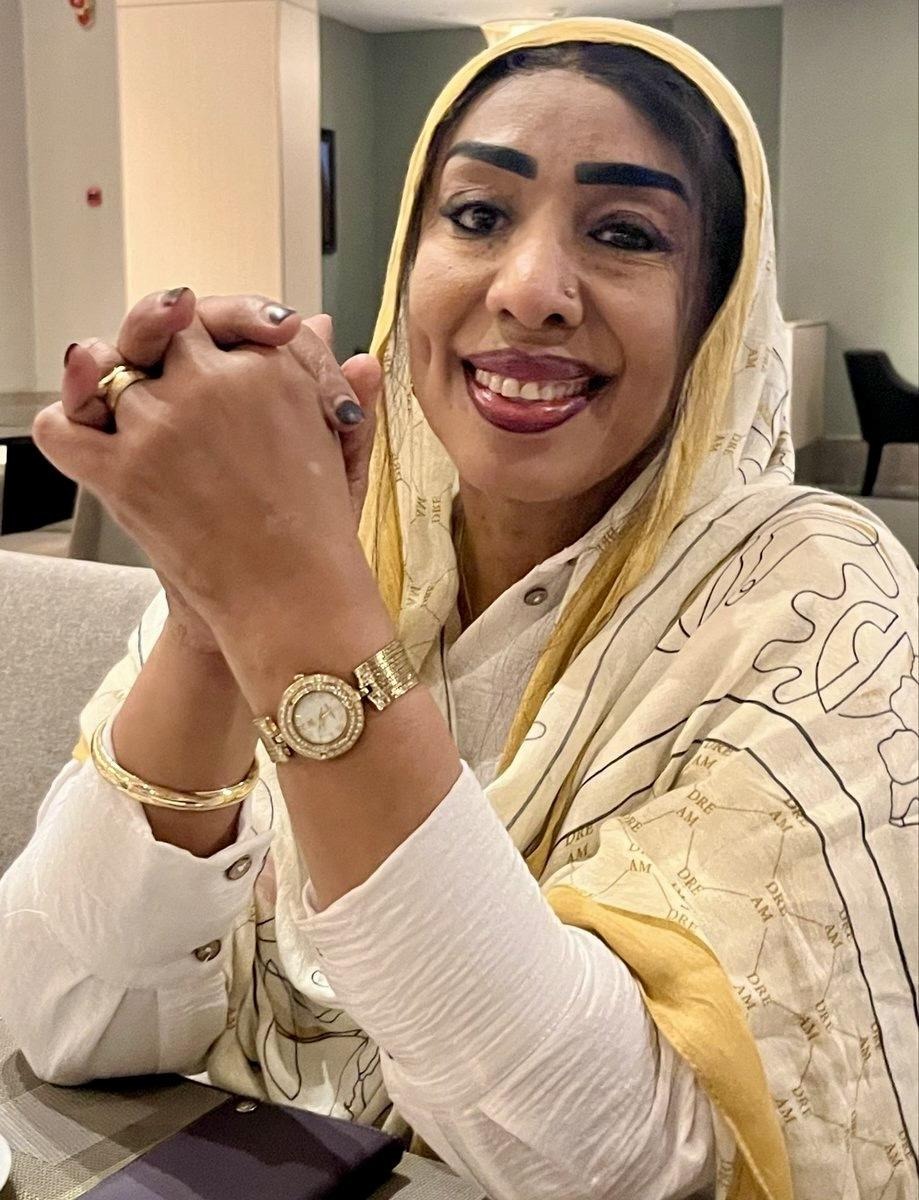
Photo: Dr. Safa Ali speaking with international journalists in Khartoum. The word “dream” is repeated across her headscarf, a striking detail in a conversation about war, survival, and the future of Sudanese women.
When we met her, there was nothing theatrical about the way she spoke.
With the precision of a physician, she described a hospital under intense pressure: shattered windows, failing electricity, scarce water, damaged equipment, too few medicines, and too few staff. Yet women kept coming, because pregnancy and childbirth do not stop for war. Birth continues whether the world is stable or falling apart. Dr. Safa Ali described women arriving after long and dangerous journeys, weakened by malnutrition and anemia, often without antenatal care, and carrying pregnancies already under immense strain. She spoke of the collapse of neonatal support, the shortages of medicine, and the lasting damage the war is doing as experienced health workers leave and younger staff are forced to fill impossible gaps.
She also described stories that were difficult to hear and impossible to forget. A pregnant woman arrived with a gunshot wound to the abdomen. The bullet tore through her womb, injured the baby, and fractured the child’s arm. Somehow both survived. Another woman, critically wounded in a missile strike, could not be saved. She and her unborn child both died. Dr. Safa Ali also treated women made pregnant through sexual violence. A colleague who was struck and killed by a stray round mid-conversation. What stood out in the way she recounted these cases was not anger or self-dramatization, but steadiness. She said the first task was to create safety, to tell survivors it was not their fault, and to treat them with dignity. In a war like Sudan’s, even basic care becomes an act of resistance.
If Dr. Safa Ali showed what leadership looks like inside a collapsed health system, Duaa Tariq revealed something equally important: what it means to defend human dignity and agency under pressure. Duaa is an activist, humanitarian, and artist. She is also the co-founder and director of Color Sudan, a collective of artists that promotes civic and political rights through art and public engagement. Since the war began, she has remained deeply involved in grassroots efforts to support civilians, including through local mutual aid and women-led initiatives. Humanitarian networks have recognized her as one of many Sudanese women who stayed in Khartoum to support those left behind.
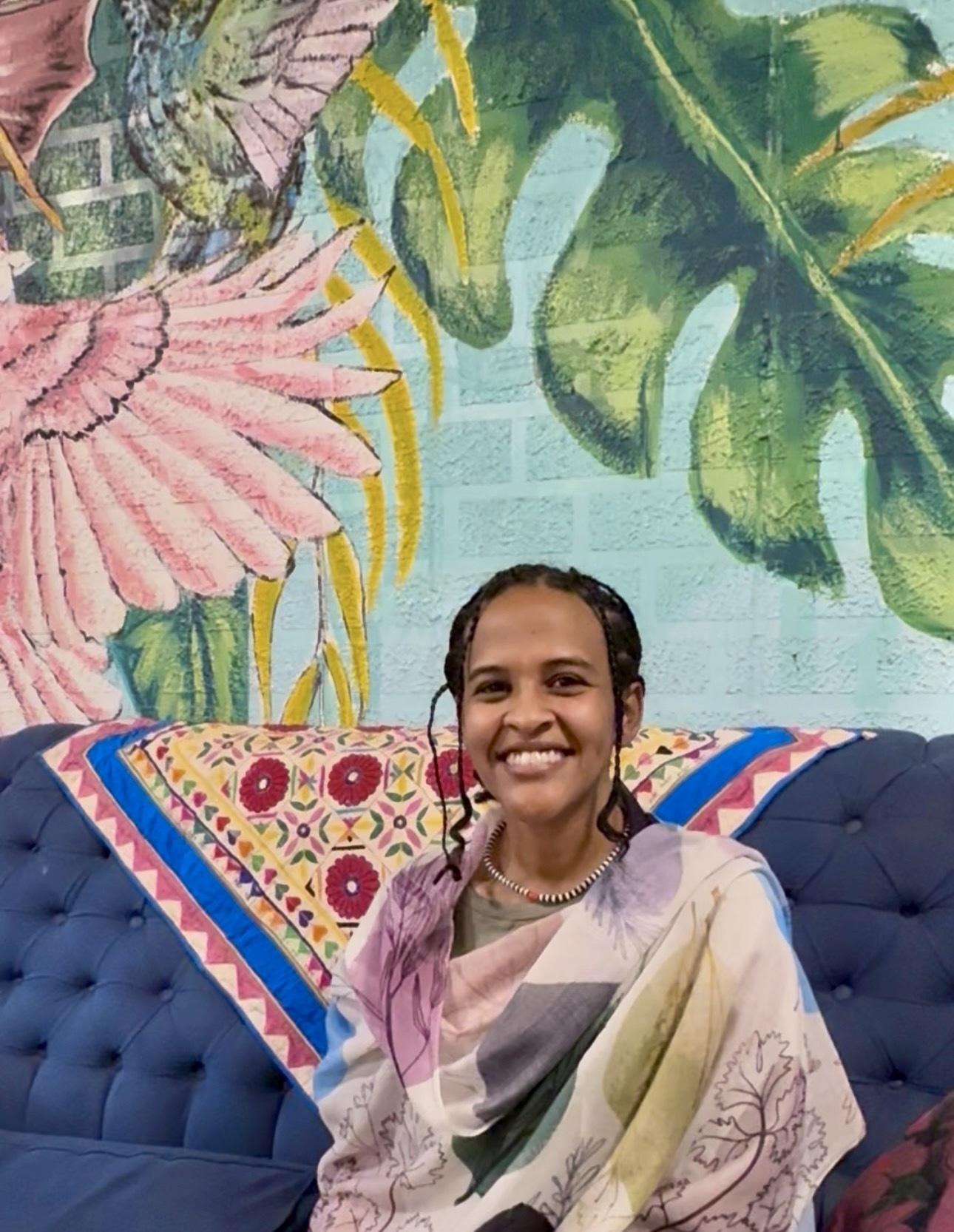
Photo: Duaa Tariq sits in front of “The Unfinished Piece” a mural that was interrupted when the war in Sudan began and the artists involved fled Khartoum.
What struck me most about Duaa was not just what she said, but what happened when the conditions around her changed. Before our interview formally began, she was warm, animated, charismatic, and full of life. But, she was careful. Government representatives were in the room listening to what she had to say to the journalists.
That moment said something profound about Sudan today.
The country is not only a place of bombs, displacement, and ruined institutions. It is also a place where people self-censor, where power enters the room quietly, and where what can be safely said depends on who is standing nearby. Duaa’s poise under those conditions was, in its own way, leadership. She represented a different but equally necessary form of courage: the courage to keep speaking, organizing, and staying present in a place where speech itself is constrained. This is hardly a surprise from a woman who insisted on going for walks in the city during the Battle of Khartoum, to demonstrate that women remained. To show other women that they are not alone.
If there was a theme that kept surfacing throughout the trip, it was this: Sudanese women are not incidental to the story of Sudan’s survival. They are central to it. In hospitals, camps, communities, and civic spaces, they are preserving life, preserving memory, and preserving some thread of continuity while so much else has been broken.
We saw that clearly near Al Dabbah, where displaced families were trying to survive amid too little sanitation, fragile water access, and clinics barely holding public health together. Even there, mothers were still trying to keep children focused on the future. Teachers were still teaching. In a retrofitted shipping container, 4-5 births happen each day. Families were still trying to impose some order on profoundly disordered lives. In camps like these, resilience is often talked about too casually, as though it were a noble trait. What we saw was not noble in the abstract. It was exhausting, practical, relentless. People were carrying life forward because they had no choice.
Sudan is often described in North America as a forgotten crisis.
That phrase is accurate, but insufficient. Sudan is not forgotten because there is nothing to see. It is forgotten because the world has chosen, again and again, to look elsewhere. Yet as the war enters another year, the scale of the emergency is staggering. More than 34 million people, roughly two-thirds of the population, now need urgent humanitarian assistance, and millions have been displaced. International officials and aid groups continue to warn that Sudan remains the world’s largest humanitarian disaster, even as global attention drifts.
That is why the courage of women like Dr. Safa Ali and Duaa Tariq matters so much. They are not symbols in the abstract. They are evidence that even under conditions of violence, surveillance, exhaustion, and profound uncertainty, leadership can still be humane, practical, and morally clear.
What I will remember most about Sudan is not only the destruction in a city of shattered glass, though there was plenty of that. It is the stubbornness of life in the middle of war. A doctor staying. An activist continuing. A mother enduring. A teacher teaching. A people insisting, despite everything, that this is still their home.
Sudan does not need pity. It needs attention, honesty, and sustained engagement. Readers should keep paying attention, even as the world’s focus is pulled in a dozen other directions, because Sudan remains too important, and too devastated, to be left to the margins. The women holding the line there deserve at least that much from us.
For The Silo, Justin McAuley/ONE.org.
ONE.ORG ONE fights for a more just world by demanding the investments needed to create economic opportunities and healthier lives in Africa.
ONE se bat pour un monde plus juste en exigeant les investissements nécessaires pour créer des opportunités économiques et des vies plus saines en Afrique.