The stunning three sheet movie poster for the lost 1926 Paramount big budget silent film The American Venus realized $35,850 to lead the day in Heritage Auctions’ July 25-26 Vintage Movie Posters Signature Auction in Beverly Hills. The auction realized, in total, more than $1.45 million. All prices include 19.5% Buyer’s Premium.
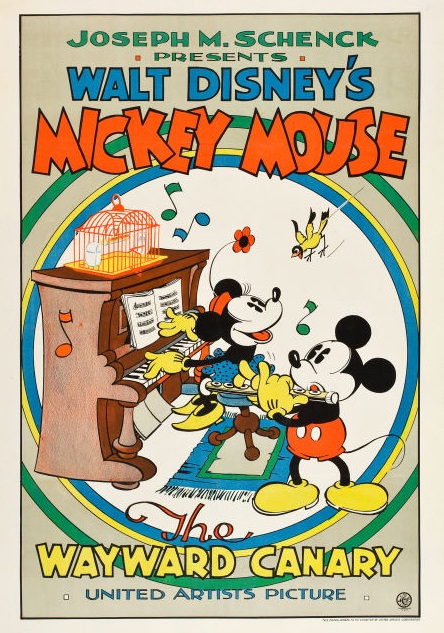
Controversy surrounds this 1932 Disney cartoon- in one scene, Mickey Mouse is seen using a cigarette lighter that has a painted swastika on it. In 1932, the world did not fully understand the significance of the swastika as it would relate to the rise of Naziism. image: Heritage Auctions
“Demand was steady and prices were, overall, quite good across the more than 1,300 lots we featured in this auction,” said Grey Smith, Director of Movie Posters at Heritage. “We saw a trifecta of focuses in this auction as collectors went after early Hollywood, Disney animation and Universal Horror. At the end of the day, we were all quite pleased with the solid results.”
The American Venus (Paramount, 1926) three sheet is a film that is now lost to history, minus a few trailers. What is known about it, however, is that the poster spectacularly features Louise Brooks, though this was only her second film appearance. She was relatively unknown at the time and her role in the film was very minor. The producers, however, obviously realized her star potential as they featured her exclusively on the poster. Brooks would go on to become one of the most iconic female stars of the late silent era.
“Brooks crafted a personal style that left an indelible mark on 1920s popular culture that’s still imitated today,” said Smith. “She achieved a cult status rarely garnered by entertainers of that time and is clearly a star that still resonates with collectors at the top of the hobby.”
Vintage posters were emotional, engaging and uniquely hand-crafted before hitting the printing press. image: Heritage Auctions
Rare and early Disney posters always create a stir when they appear at auction and the presence of a 1932 United Artists one sheet for Disney’s The Wayward Canary, depicting Mickey and Minnie Mouse, set collectors buzzing on its way to a $26,920 final price realized. Released in November 1932, the same year that the Academy awarded Disney a special Oscar for his creation of a nationwide phenomenon, Mickey Mouse, this is a key addition to any top Disney collection.
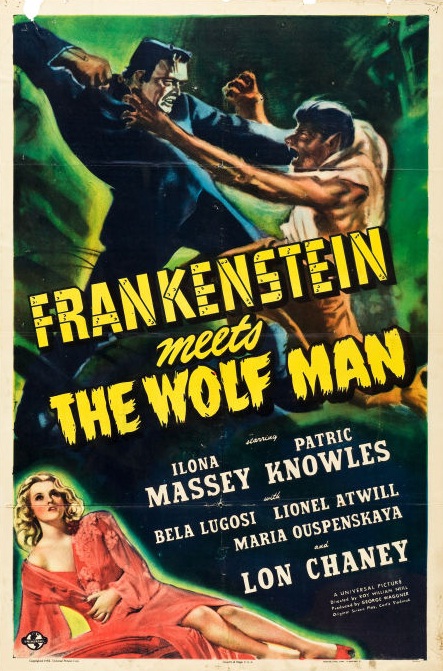
Universal Horror posters are still the gold standard in movie posters and this auction boasted several prime pieces from the top films of the genre, including a beautiful pre-war 1935 Belgian one sheet for Bride of Frankenstein, James Whale’s sequel to his 1931 masterpiece Frankenstein that quickly became a classic in its own right, realizing $20,315 from a determined collector, while a 1943 one sheet for Frankenstein Meets the Wolf Man — often cited as one of the best posters in the Universal horror cannon — was the subject of intense collector interest before finding a new home at $15,535.
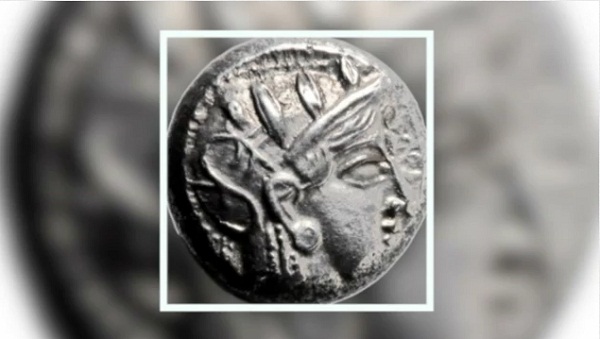
Incredibly rare “Owl type” Silver Drachm (opposite face with Jerusalem lily) image:courtesy Heritage Auctions
The first silver shekel struck in Jerusalem by Jewish forces rebelling against Roman oppression in the first century CE, one of only two specimens known, brought a world record price of $1,105,375 at Heritage Auctions on March 8 as part of the auction of The Shoshana Collection of Ancient Coins of Judea. The coin sold to an anonymous overseas collector. Overall, this auction realized over $7.6 million, with the whole of the collection, consisting of more than 2200 coins in total, expected to realize more than $10 million in multiple auctions this year.
“This Year 1 silver shekel, struck shortly after the Jewish War began in May of 66 CE, is an incredible piece of history,” said Cris Bierrenbach, Executive Vice President of Heritage Auctions. “This is literally one of the very first coins the Jewish rebels struck after the ousted the Romans from Jerusalem, sending shockwaves through the empire. That history, as evidenced by the spirited bidding and the superb price realized, obviously continues to resonate today, more than 2,000 years later.”
The Shoshana Collection, assembled over the course of four decades by an American collector, is the greatest assembly of ancient coins related to the foundation of ancient Israel ever offered, spanning more than 11 centuries.
Other highlights from the collection include an incredibly rare gold aureus as Caesar (69-79 CE), struck at an Eastern mint in 69 CE, likely Tyre, anticipating the subjugation of Judaea, which the Romans achieved with the fall of Jerusalem in 70 CE, which brought $956,000, while one of only two known surviving silver quarter-shekels of Year 1 (May 66-March 67 CE) in existence brought $896,250.
A few of the additional highlights included:
Jewish War (66 – 70 AD). AR half shekel. Year 4. Hendin 1365. TJC 209. AJC 262,25. Samuels 980 (this coin). Extremely Fine. One of six recorded specimens. Realized: $358,500.
Vespasian (69 – 79 AD). AE sestertius. AD 71 Rome. Hendin 1500b. RIC 71,161. BMC 543. Impressive Good Extremely Fine. Realized: $262,900.
Jewish War (66 – 70 AD). AR shekel. Year 5. Hendin 1370. TJC 215. AJC 263,31. Samuels 94 (this coin). Very Fine. Ex: Nelson Bunker Hunt. Realized: $262,900.
Jewish War (66 – 70 AD). Year 5. Hendin 1370. TJC 215. AJC II 263,31. Brand 3. Bromberg II, 309 Good Very Fine. Realized: $179,250.
Divus Vespasian (69 – 79 AD). AV aureus. Struck by Titus, AD 80-81, Rome. Hendin 1581. RIC 230,363. Cohen 143. BN 89. Superb. Realized: $131,450.
Aelia Capitolina (Jerusalem, renamed by Hadrian) Collection, 164 coins. Realized: $107,550.
Titus as Caesar (79 – 81 AD). AV aureus. AD 72-73 Rome. Hendin 1469. RIC 84, 370. BMC 520. BN 73. About Extremely Fine. Realized: $101,575.
Vespasian (69 – 79 AD). AE sestertius. AD 71 Rome. Hendin 1500b. RIC 71,161. BMC 543. Samuels 146 (this coin). Extremely Fine. Realized: $95,600.
Bar Kokhba Revolt (132 – 135 AD). AR sela. First year (132/133 AD). Mildenberg 125,4.1 (this coin). Hendin 1373. TJC 218c (this coin). AJC 264,1c (this coin). Samuels 98 (this coin). Superb. Realized: $89,625.
Bar Kokhba Revolt (132 – 135 AD). AR sela. First year (132/133 AD). Mildenberg 124,3.5 (this coin). Hendin 1373. TJC 218 (these dies). AJC 264,1 (these dies). Samuels 97 (this coin). Superb. Realized: $89,625.
Auction of US coins continues on New York and over the Internet at www.HA.com/Coins through Sunday, March 11.
Seldom Seen Selections: One of the finest known 1795 Eagles
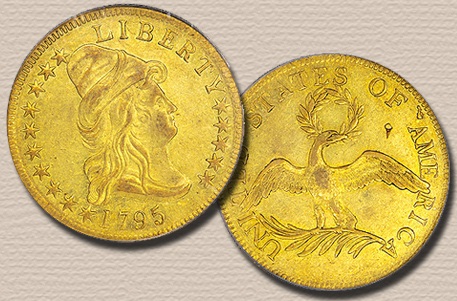
The famous 1795 American gold ‘eagle’ coin
The ten dollar gold pieces, given the name “eagle,” were the largest gold coins produced by the first U.S. Mint from 1795 through 1804. Like all early gold coins (and many early silver coins), these pieces did not carry an actual denomination as part of the design.
The 1795 BD1 is considered the first variety coined for the year, therefore it is the first eagle minted by the United States! There are more of them surviving today than all other 1795 varieties combined, and it is actually one of the five most common die varieties of the entire series from 1795 to 1804, a fact that would probably surprise most collectors. Quite a few examples survive in Mint State grades, giving collectors a reasonable chance of obtaining a high-quality example of the Small Eagle reverse design.
Many of the Mint State pieces have prooflike fields, including the coin we are featuring in our upcoming 2012 April 18-22 US Coins & Platinum Night CSNS Signature Auction. Although the fields are not deeply mirrored, they are clearly reflective. The surfaces are exceptional with only a few scattered abrasions. Faint adjustment marks are evident at the center obverse and on some of the obverse dentils. All design elements on both sides are sharply struck, suggesting to some the possibility that this may have been some type of presentation piece. This example is a relatively early die state of the variety, with faint obverse die cracks but no evidence of reverse cracks. Despite the existence of several Mint State pieces, this example is one of the most attractive we have handled.
A curious situation exists for both early half eagles and early eagles. For both denominations there were multiple varieties dated 1795 and only a single variety dated 1796, despite mintages that suggest this is illogical. During the course of 1795, just 2,795 eagles were minted from September 22 through November 27. In 1796, the Mint produced 6,934 eagles from January 9 through December 22. If we take these annual production totals at face value, an average of 560 coins per die marriage were struck in 1795 while a single die marriage produced all 6,934 coins in 1796. Clearly there is something wrong, unless many of the coins produced in 1796 were from dies dated 1795, and we can be certain that this was the case. According to the Guide Book, the 1795 mintage totaled 5,583 coins and the 1796 mintage totaled 4,146 coins, but even those figures are suspect, suggesting a survival rate of 10% for 1795 eagles and only 4% for 1796 eagles. This discussion illustrates the challenge that numismatists have today when attempting to reconstruct the events of the earliest years at the Philadelphia Mint. There were no records of mintages for individual die varieties, and any attempt to make such estimates today is plagued with problems.
In Early U.S. Gold Coin Varieties, John Dannreuther provides estimated mintages for every variety and for the number of survivors for each variety. The only thing we know for sure is the number of die marriages known from 1795 through 1804 (32) and the total mintage for that period (132,714 coins including 122 pieces reserved for assay). By using the midpoint of Dannreuther’s survival estimates, we can also establish an approximate survival rate for the series of 2.5%. Is this enough information to establish original “mintage figures” for each variety or even for each coinage date?
Mark Van Winkle has spent considerable effort over several years attempting to correlate mintage figures with individual varieties, and now feels that it is impossible. There are at least two variables that cannot accurately be determined. First, the exact emission sequence needs to be determined (including both die marriages and remarriages). In a series like the early eagles, the emission sequence alone is enough to give a numismatist nightmares. Once the emission order is known, an accurate estimate of the survivors must be established for each variety and remarriage, and this is nearly an impossibility. Finally, differing survival rates from one coinage date to the next must be pinpointed, a seemingly impossible task. CP for Heritage Auctions Dallas, Texas www.ha.com
Supplemental– The Numismatic Network of Canada for those interested in studying and collecting Canadian coins, tokens, paper money and related numismatic materials http://www.nunet.ca/
How can we honestly say that today’s rain and overcast skies influenced our choice for today’s 90’s flashback…umm, urr, we can’t. But this throwback track from R.E.M. rocks. Pack your umbrella for the next few days and if you’ve got room on your ipod (we’re guessing you do, and if you don’t drop us a line explaining why not) , add this song to your playlist. It just might be a cure-all for the turn in the weather. Now where did i put my can of orange Crush?
CP
Back in the mid 80’s, my high school buddies and I would travel every month or so from Simcoe to the Brantford Civic Center to get our fill of WWF wrestling. It was great because in those days they used to do the TV taping right there in Brantford for broadcast all over North America. It was usually a long night of about 3 hours of wrestling for 3 different TV shows. For $5 it was the best entertainment value around. Sometimes the matches would drag on.
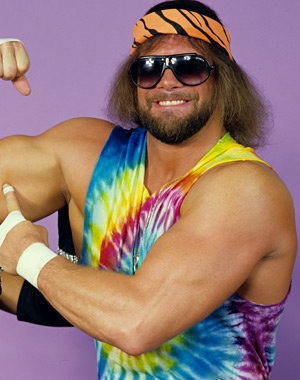
Harley Race and Nikolai Volkoff were not exactly the most captivating performers, but we would endure them waiting for something to peak our interest. I’ll never forget the night a new wrestler was introduced to us. The ring announcer welcomed him as Randy ‘Macho Man’ Savage. Out he came in a garish, metallic robe which reflected the television lights in a million directions. He had a maniacal look on his face and he revealed the craziest wild eyes when he finally removed his dark ski-goggle type sunglasses. His matted hair was held back by a colourful headband and he sported an unruly beard.
Once in the ring, he took off the robe to reveal not the plodding weightlifter type body we were used to seeing, but the more sinewy muscularity of an athlete. We, the veteran and savvy fans, took this new guy and his ring entrance with a grain of salt. “Macho Man”? Really? “Who calls themselves the “Macho Man”?” we thought. At that time our only reference to a Macho Man was voiced by a pop group named the Village People, and that was just plain challenging for a group of adolescent high school boys. So we watched on with wary eyes. The bell rung, the match started, and then the Macho Man turned into a human whirlwind.
He raced around the ring delivering all his moves with expert efficiency, but at a hyper-speed we had never seen before. He threw his man out of the ring, darted up to the top turnbuckle and came down hard onto the opponent’s backside with a double axe handle. He then threw the poor sod back in, picked him up and body-slammed him to the centre of the ring and jumped back up onto the top turnbuckle as quick as a cat. What was he going to do now? He raised his arms and pointed his fingers up high towards the arena roof and paused for a moment while the crowd held its collective breath. Then….he leapt. Sky-high into the air he launched, coming down with devastating force into the chest of his opponent with what would become his signature move, the Flying Elbow. One, two, three, and it was all over in the blink of an eye. We were awestruck. A star was born. After that display of wrestling awesomeness, it goes without saying that we were now all charter members of the Macho Madness fan club.
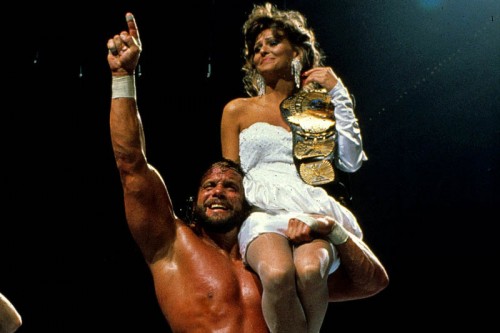
Savage’s “Oooooyyeeaaah” catch phrase and white-hot interviews would solidify his character, and his lovely manager Elizabeth would provide the eye candy which surely helped propel him to the highest heights of wrestling stardom. Whenever his entrance music, “Pomp and Circumstance” hit, the excitement level dialled up to a fever pitch. He would become a multi-time WWF champion and face off against Hulk Hogan in the top money-drawing program of the day. His crowning achievement was likely his match against Ricky Steamboat at Wrestlemania 3 in what is widely regarded as one of the best wrestling matches of all time.
Randy Savage, real name Randy Poffo, died tragically in Florida last month after having a heart attack while driving his car and then colliding with a tree. He leaves us at the too young age of 58. I know my buddies and I are not the only ones out there missing him. I’m sure some of you have your own favourite Macho Man moments.
Maybe you should have a stroll down memory lane and check out some Macho Man on Youtube In my mind, he was thegreatest of all time. John McIntosh is a favourite writer for The Silo.