Tag Archives: Pink Floyd

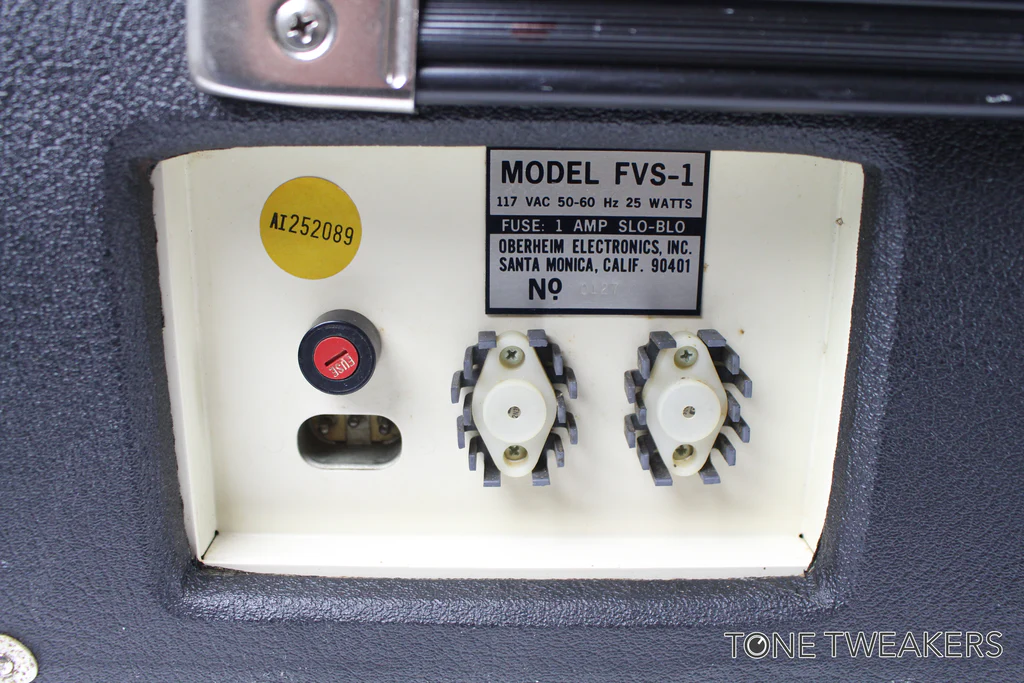
A Synth Holy Grail- Oberheim FVS-1

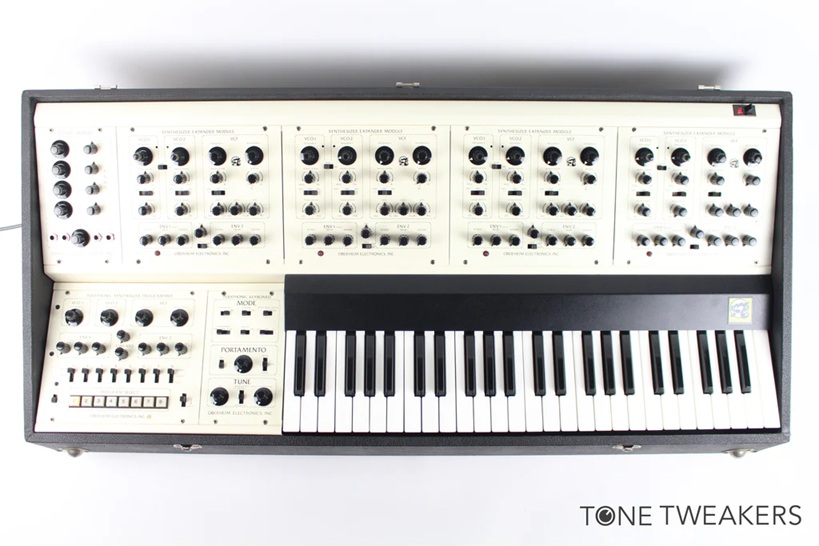
Considered by many to be The Holy Grail of Polyphonic Synthesis, this meticulously refurbished Oberheim FVS-1 took 88 hours of skilled vintage synth tech time via our friends at tonetweakers to perfect. The FVS-1 contains 4 classic Oberheim SEM modules, each providing a single dual oscillator voice. Sounds are dialed in manually on each module, with global control over the most tweaked parameters via the programmer module, where patches are also saved and recalled. Since each SEM is manually adjusted, it’s hard to get them sounding exactly the same. The result is a much more organic, slightly detuned, richer, truly magical sound than you’d get out of most other poly synths.

Famous users include Lyle Mays, 808 State, Depeche Mode, Styx, Pink Floyd, The Shamen, Gary Wright, Joe Zawinul and John Carpenter (yep the film director of The Thing, Big Trouble in Little China, Starman, Escape From New York and other classics often composed and recorded music for his movies). You won’t find a better example of this beautiful classic synthesizer, so if you’re looking for an exceptional 4 voice, now’s the time. Visit our friends at tonetweakers.com to learn more.

The OB Four Voice contains 4 SEMs and a mixer module. This beautiful instrument can play up to 8 oscillators at once, for insanely humongous sounds. 
One of the first

The 4 voice was one of the first polyphonic synths. Each of the four Synthesizer Expander Modules ( SEM ) can be assigned to a different note. Splitting voices between modules is also possible, as is a monophonic unison mode. A single voice is surprisingly powerful, offering 2 oscillators, 2 envelopes (1 for filter, 1 for volume), an LFO, pulse width modulation and a real sweet multimode filter with sweep-able mode (which few synths offered). The programmer module allows fast saving and recall of programmed sounds. With a combined 8 oscillators, these sound unbelievably fat. Even a single SEM sounds great. In unison mode, play all VCOs on one key for one of the most powerful vintage synth sounds ever. Nothing sounds like it to us and we’ve played everything. This is a personal favorite. This FVS-1 has the standard configuration of modules: 4 x Synthesizer Expander Module ( SEM ) Keyboard Output module Polyphonic Keyboard module Programmer module.

No clangs or zaps


If you are an analog synth head who makes musical sounds, you need one of these. To avoid disappointment though, we would recommend anyone looking for a dedicated sound effects machine to go for something else. This 4 voice is fabulous at musical tones and can make some interesting sound effects but there are better choices for clangs, zaps, explosions and similar atonal timbres. 

Other famous users include: Joe Zawinul, Chick Corea, Larry Fast (Synergy), Jan Hammer, Herbie Hancock, Human League, Michael McDonald / Doobie Brothers, Patrick Moraz, Steve Porcaro, The Shamen, Tim Simenon, Depeche Mode, Vince Clarke / Erasure, Tangerine Dream, Stevie Wonder and many other influential musicians who could afford one – this was a very expensive instrument when it came out! 
My Magical Mystery Tour of Abbey Road Studio In London

Have you ever experienced something surreal?

I had reason to visit and work at Abbey Road Studio in London, and it still seems surreal!! My colleague Jayson Tomlin, Gary Katz (producer of Steely Dan), and myself were there to do testing and evaluation of some new technologies we’ve been working on for broadcast and consumer applications.

We spent a full day working in one of the mix-down studios, along with members of the BBC, Scotland Yard, Abbey Road, David Perreau, Felix Konrad, and some of Gary’s record producer ‘buddies”…Hugh Padgham (Genesis, Rush, Phil Collins, Police, Sting, XTC), and Elliott Randall (studio guitarist for Steely Dan).

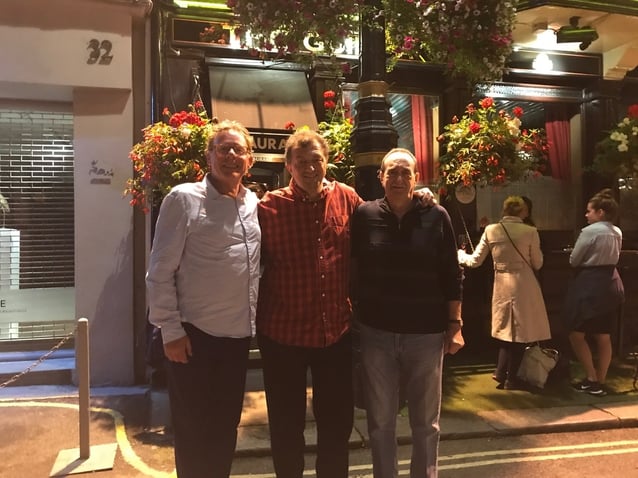
Frank with Hugh Padgham (left) and Gary Katz (right)

Our connection with Gary has enabled us to connect with key members of the music production world, which in turn has enabled us to further evolve technologies for broadcast, and soon the consumer markets. Our work at Abbey Road was another step along this process, and it raised the bar for us, on what is expected of our products.

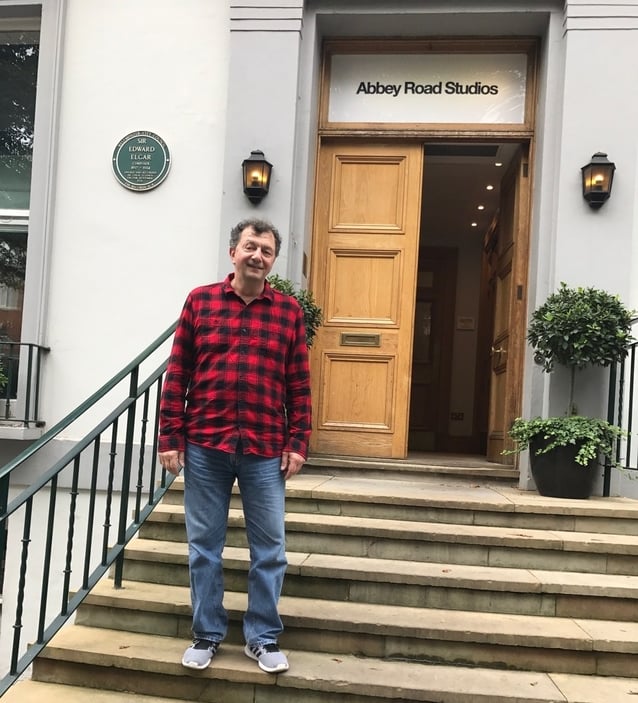
Frank on the steps of Abbey Road Studios

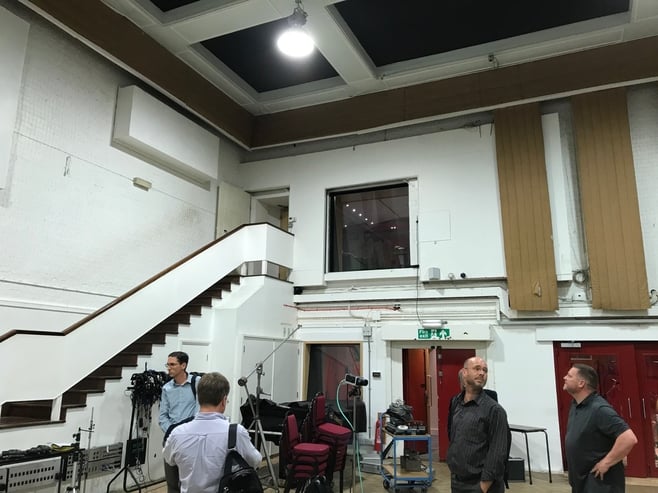
Being able to set foot into the building and studio where the Beatles recorded and produced all of their material was breathtaking. I’ll never forget, as we were wrapping up the events for the day, the studio engineer, whom we were working with, said “hey guys come with me, two is now open!” In my mind I’m thinking “this is where all the ‘magic’ happened.” So, off we went, and sure enough we walk into studio #2, and it’s still pretty much the same as if John, Paul, George, and Ringo were there the day before.  Getting chills—again—as I write this!!

Jayson Tomlin and others take in Studio #2

Probably the most gratifying moment that day was towards the end. Hugh Padgham had been listening to some tech I’d developed, and told me how he’d done work with the late George Martin. His comment was how he had a good sense about how George produced the Beatles, and could we apply my ‘gizmo’ to their music.

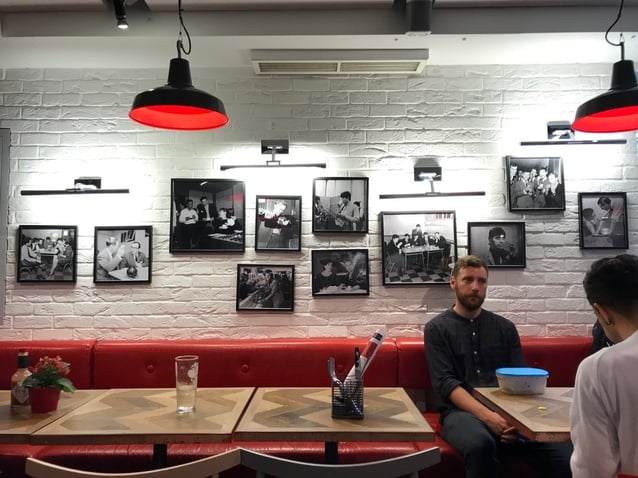
Abbey Road Cafeteria

So…in the building they recorded the album Abbey Road, we added some treatment to the song “Golden Slumbers.” Together, all of us were in awe to hear the Beatles music, with some treatment from our efforts, done at Abbey Road!

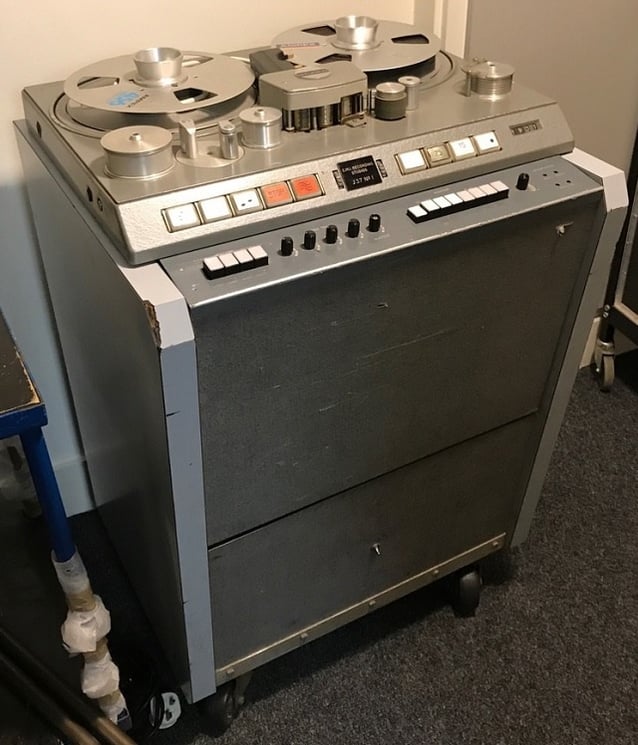
Tape deck used in the recording of Sgt. Pepper's
Tape deck used in the recording of Sgt. Pepper’s

There’s a skylight in the ceiling of the studio we were working in. While listening, I looked upward through the skylight, and thought, “if Mr. Martin, Mr. Lennon, and Mr. Harrison are listening, my hope is you won’t feel I let you down.” I felt a tear trickle down upon having this thought. Quite possibly one of the coolest occurrences in this boy’s life!!

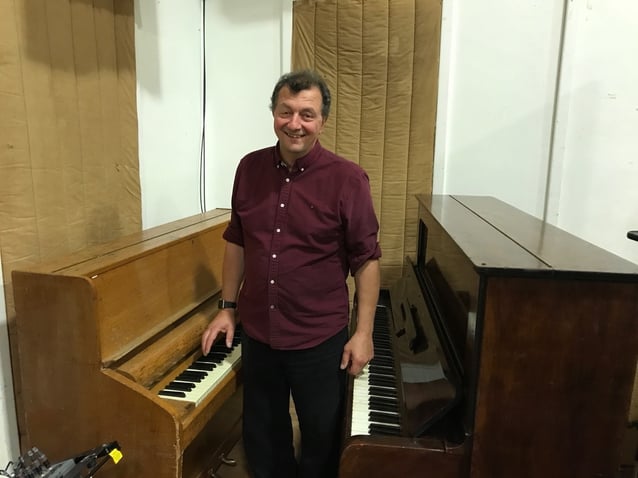
Frank between pianos used for the Beatles' “Get Back” and John Lennon's “Imagine”
Frank between pianos used for the Beatles’ “Get Back” and John Lennon’s “Imagine”

Modestly, it was reassuring when each of our well-known music industry guests gave us the “thumbs up’ for our efforts. Further indication of how our little organization keeps growing and raising the bar! In closing, my sincere thanks to Jayson Tomlin, Gary Katz, Hugh Padgham, Andrew Scheps, and Elliott Randall for your feedback and friendship!!

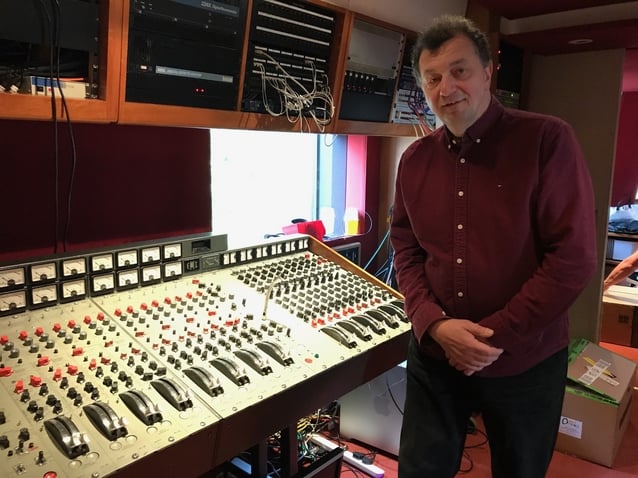
Recording mixer used to record Pink Floyd's The Dark Side of the Moon
Recording mixer used to record Pink Floyd’s The Dark Side of the Moon

For the Silo, Frank Foti.

Stereo Equip Manufacturer Opens Record Studio To Level The Field

It’s been nearly two years since we moved into our new digs in Boulder, Colorado. The most exciting part has been watching our recording/mastering studio, led by engineer Gus Skinas, come to life. Gus is a close friend and one of the nicest and most humble gents around. The world knows Gus from his work on projects for Pink Floyd, The Rolling Stones, Stevie Wonder, Elton John, Al Kooper, George Harrison, Queen, Joni Mitchell, Chick Corea, Frank Zappa, and The Police (to mention a few). His talent is unmatched, and we’re proud to have him in the hi-fi family.


A few days ago, we made a big step forward. With Gus at the helm, PS Audio has launched our much-anticipated music label: Octave Records.

Almost every time I give a tour at the new facility I get questions about Octave. With hundreds of labels out there, what makes Octave different? You and Paul make components, why the expansion into recording? Are you just doing this because it’s cool?

Guilty as charged!

In truth, we started Octave Records for the same reason we design audio components—because we know we can make a difference. We know we can produce albums with superior sonic quality and we also remain keenly aware of the challenges faced by so many music creators. Labels have been known to sacrifice quality for profits and for mass-market appeal. For albums-sold, most labels compensate artists with pennies on the dollar. Oftentimes, labels insist on owning the artist’s music. We believe the music deserves high-quality presentation and that the artists deserve to be honored for their contributions. It’s the artists, after all, who give rise to our entire industry.

So we decided to build a label the way we think it ought to be. Octave Records uses the finest studio equipment, all centered around the acclaimed Sonoma DSD recording, mixing and mastering system. We asked Gus to personally craft each recording. And to better support musicians, Octave Records covers 100% of the studio, mixing, mastering, production, distribution and marketing costs. We also provide artists with a direct-share of retail revenues, which are ten to twenty times that of other labels. At Octave Records, the artists own their music, and we give them creative control. They’ve earned it…and we get to enjoy the fruits of their labors on our hi-fi systems!

“Along with our dedication to producing the best-sounding recordings available today, Octave Records offers a different kind of business model,” said Paul McGowan, PS Audio CEO. To support musicians, Octave covers 100% of all studio, mixing, mastering, production, distribution and marketing expenses so that artists may directly share in retain sales revenues – while also retaining ownership of their music.”


It’s with great pride that we announce the first album from Octave Records: Out of Thin Air, a solo piano performance from renowned pianist Don Grusin.


Offered in SACD, native DSD (DVD-Audio) and CD formats, you can learn more about Octave Records and listen to samples of Grusin’s new album here https://www.psaudio.com/products/out-of-thin-air/ If you are interested in picking up a copy of this limited edition, they are available with world-wide distribution (direct from us in Boulder), however, this album is not available for digital download at this time.

I hope you enjoy listening to the album as much as we have enjoyed making it. This is the first of many. For the Silo, Scott McGowan.