Tag Archives: community

FCC Promoted American Broadband Competition And Net Neutrality

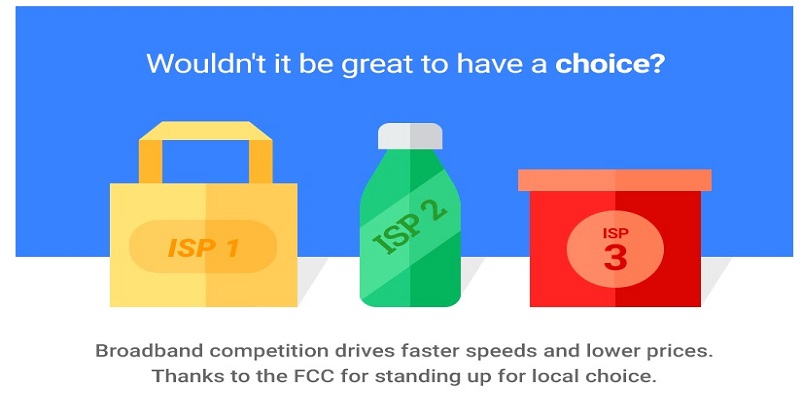
In late 2014- early 2015, the FCC stood up for more competition and more choice in local broadband. This is a critical step in making faster, cheaper Internet available for all Americans.

You may have heard that the Federal Communications Commission (FCC) just put in place rules to protect ‘net neutrality.’ That’s big news. But there was another important decision today to help keep the Internet competitive and open — and while it’s getting less attention, it may be just as important. As part of its agenda to encourage meaningful competition in high speed broadband for Americans, the FCC supported allowing cities to make their own decisions about investing in new broadband networks. More needs to be done to drive innovation in bigger, faster broadband, but this was a good step.

Canadian ISP client

While the FCC’s net neutrality rules can help prevent Internet access providers from relegating some applications to a “slow lane,” this move alone won’t lead to a world where every consumer has an ultra fast connection to the entire Internet. That’s going to take more competition and innovation in new broadband networks.

It’s been nearly five years since we offered to build a fiber-optic network in one U.S. city as an experiment — and as we’ve expanded Google Fiber into a business, we’ve seen firsthand how faster speeds can improve lives and give cities new platforms for economic development. Google is not the only one innovating in this area. Along with investments by other private providers, cities like Lafayette, LA and Chattanooga, TN have been investing in their own networks and developing public-private partnerships to that end.

The FCC decided that it’s important for users to be able to control their own Internet connections and for communities to make their own choices to suit their local needs for broadband. While it may not make sense for most governments to operate broadband networks themselves, we think faster, better broadband for all Americans is too important to remove an option for deployment.

Thank Chairman Wheeler and the FCC for supporting local choice and competition in broadband networks: https://takeaction.withgoogle.com/thank-the-fcc     For the Silo, Derek Slater Google Inc.

P.S. If you want to learn more about the ingenuity of cities supporting broadband investment and competition, check out Next Century Cities.

Supplemental- Test if your Internet Service Provider is “throttling down” your internet connection speed. (requires Java plug-in installed)

How competitive is the Canadian Residential Broadband Market?  ( Essay from 2009- has anything improved since?)

 

A New Light On Autism

Let there be light

Have you ever noticed how experts constantly refer to Autism as a ‘learning disability’?  I contemplate this term as I watch my nine-year-old son Braydon, effortlessly scale my counter tops to filch the salt and vinegar chips I hid in top shelf.  In fact, Braydon’s problem solving skills exceed that of his ‘neurotypical’ sister.

What would I change in my son’s treatment if I considered my son to have a communication disability rather then a learning disability?  Is this just a title or is it maybe a new perspective?

I am not an expert but here is what I do know.  Individuals who are visually or hearing impaired are considered to have a communication disability.

There are so many reasons why the sensory processing centers in the brains of certain individuals do not receive the input messages from their eyes or ears (or both like Helen Keller).  Autism looks much the same to me.  The sound of my voice competes with all the other sensory information that Braydon is so sensitive to.

The ticking of the clock, the air is too warm or too cold, his seat is too hard or too soft, the bathroom door is about to open and he is going to run away to close it.  These things make up only a fraction of the information coming at my son at all the same intensity!  Braydon’s moderate-severe Autism means that unlike those of us that experts consider ‘neurotypical’, he has no way to filter this information except to create an ‘output’ to counter it.  Experts call this behavior ‘stimming’.  I realize this all sounds confusing, but my point is that High Functioning Autism, like Blindness or Deafness comes down to being a sensory processing issue rather then an inability to learn as the term ‘learning disability’ seems to suggest.


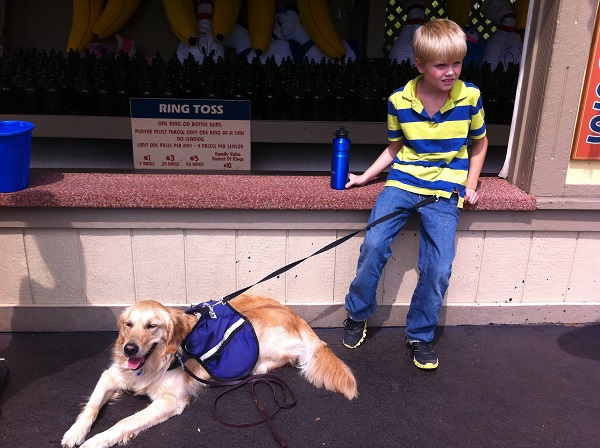
Braydon and Whoopi
Braydon and Whoopi

Perhaps this is the reason why a Certified Autism Service Dog has proven to be such an asset to our quality of life?  Service Dogs for the blind and hearing impaired are fairly common.  Is a service dog for a person with Autism a truly enormous stretch?  Trust me, it is a natural progression.

If perforated dots on a piece of paper can give a child who is born without the sense of sight an opportunity to read a book, or a computer can give Carly Fleichman, a girl with asphyxia and Autism the opportunity to find her voice, in theory my son could be able to learn the skills he is going to need to become a contributing member to his community.  Just look at all the things Dr. Temple Grandin was able to accomplish!

My goals suddenly look much different.  Instead of trying to convince my son to learn, perhaps I need only to teach him how to communicate. For the Silo, Jenny Tansley.

Supplemental- From the Silo Summer 2010 Temple Grandin article https://www.thesilo.ca/temple-grandin-a-silo-movie-review-issue2/