Moon

Art imitates rural life.

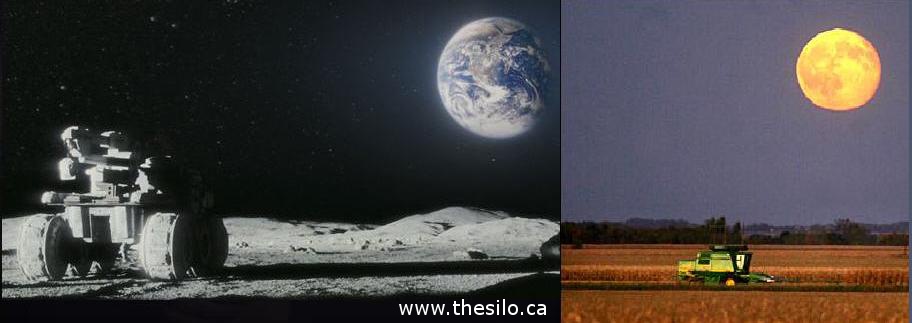
If you’re like me and grew up on a rich diet of 1980’s science fiction films, you should walk (no make that moonwalk) to your nearest video store and ask for MOON. This little gem is an existential journey into the mind of a lonely farmer-astronaut and hits close to home. Sure there’s the usual high contrast and gritty sci-fi production values, but there are also some poignant connections to our rural habitat. Picture a massive, rambling, white combine harvester gathering hay under a full, late fall moon, except that in this case the moon is the earth. A tiny, lonely man is hunched over the controls in an elevated and sealed cockpit. Now remove all semblance of colour, add a few craters and hills, and you get part of what makes this film so familiar and, dare I say, rural.

Growing up here as a boy I imagined that the once plentiful silos and drive-sheds in Norfolk (especially the aluminum ones) were rocket platforms and moon bases. Even the large, four wheeled crop sprayers had a space age look to them. And that is why I felt especially connected to Duncan Jones’ incredibly moving MOON. It pulled me in and felt familiar.

If I had to bet the farm I’d say the production designer looked at both farms and farm machinery while working out the aesthetics of this movie. But more than that, the story pulls at your heartstrings.

Sam (played by the remarkably versatile Sam Rockwell in a breakthrough role) is a lonely astronaut working on the moon, farming the soil for energy until he begins to suffer from extreme isolation- complete with lucid dreams and hallucinations. What follows next is one of the finest surprise plot twists in contemporary cinema.

Satisfying space fiction from son of iconic rocker David Bowie. For the Silo, Jarrod Barker. 
Rural Ontario Archaeology

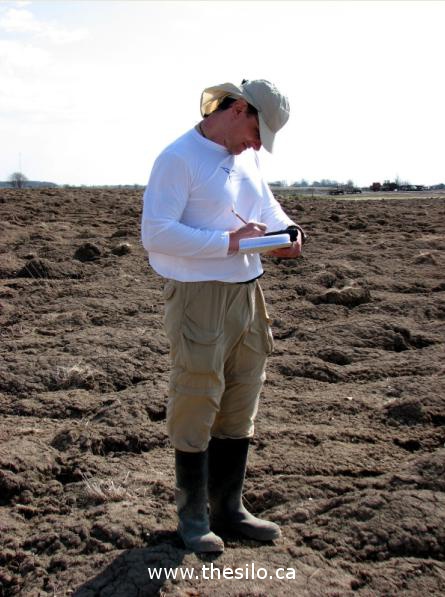
Lorenz taking notes in the field

I was raised in the dairy farming community of Jarvis in Haldimand County.  Since dairy was on the decline my family and I decided I would go to university. I began the study of archeology, and The Haldimand Norfolk Archaeological Research Project (HNARP) is a scientific study intended for my doctoral dissertation.

I selected this region because as a youth I walked across many of the county concessions and came to have an understanding of the landscape. In addition, there is continuous encroachment on the farm lands in the form of housing subdivisions in growing communities, industrial development along the lakeshore, and external landowners waiting to develop the land. The long term goal of the HNARP is to improve current evidence of prehistoric climate change and to determine its impact on early people. A study has never before been undertaken in Ontario over such a large parcel of land, and it needs to be done now before the opportunity is lost forever.

When the Laurentide ice sheet began receding 20,000 years ago the lands left behind were devastated by glaciers that destroyed plant life and any chance for animal or human survival. The first hints of people in the region date back 11,000 years. Evidence of their existence is in the form of stone debris and tools left behind on the ground. In fact,  Haldimand is the locus of our study because of the abundant chert formations in the region (chert is a type of flinty rock). These were a continuous draw for early people constantly in need of stone for tools and weapons. This same geology is the source of the quarry rock that provides jobs and careers in the community today.

Which brings us to one of the most rewarding outcomes of this kind of archeology: the people of Haldimand-Norfolk will begin to understand their relationship to the land as part of a 10,000 year history of human habitation. By systematically studying the major watersheds we can learn much of both archeological and environmental importance. Settlement patterns emerge. We begin to see how fluctuations in the climate of the Great Lakes region impacted plant and animal life, and the seasonal availability of certain foods. As we learn about the past we discover connections to the present, and can plan more effectively for the future. But the evidence we need can only exist under certain conditions, and development is not one of them. The HNARP must act now to learn what we can.

Our success depends on agricultural landowners acting as stewards, to preserve and protect archaeological sites so they can be properly interpreted and understood. People are often concerned about what an archeological study on their lands might mean. Let me alleviate some of those concerns. The HNARP regional study is conducted on private property. That means simply: your land remains your land. All information relating to this scientific study is strictly private and confidential. No information is made public or shared with any institution or public organization.  Generally, landowners can continue their farming practices without any interruption from this study.

One of the most interesting aspects of our work is something we call “community archaeology.” Interested community members can volunteer to be trained in to work with HNARP members, and become part of the discovery themselves.  For the Silo, Lorenz Bruechert.