Tag Archives: Arts and Architecture Magazine

LA’s Famous Atomic Age Stahl House For Sale

LA’s Stahl House – Most Famous US Modern Home Since Fallingwater – Lists $25 Million usd/ $34.3 Million cad

In 1945, Arts and Architecture magazine commissioned major architects to create the Case Study Homes, an experiment in architectural design intended as a creative solution to the impending post-war housing boom. Constructed from industrial materials, these homes would help to define the mid-century modern movement, none more so than Case Study House #22, known as the Stahl House.

The Pierre Koenig masterpiece is cantilevered over a Hollywood hillside, which had been deemed unbuildable by previous architects. The home was immortalized by renowned photographer Julius Shulman in an image that shows two women in white party dresses lounging in the living room that seems to float above the glittering city.

It is perhaps the most famous modern-style US home and architectural photograph since Frank Lloyd Wright’s 1930s Fallingwater. A true cultural landmark, the home is a City of Los Angeles Historic-Cultural Monument and listed on the National Register of Historic Places. 

Owned by the Stahl family since its inception, this one-of-a-kind icon of modern design has hit the market for the first time.

Representing the optimism of the atomic age, the Stahl House features the steel-and-glass construction so emblematic of the modern movement. Its legendary glass walls were created from the largest glass panels commercially available when it was built between 1958 and 1960. They offer sweeping 270-degree views of Los Angeles. A picture window in the primary bathroom frames the Hollywood Sign. 

An airy open floor plan connects the living spaces in the 2,200-square-foot home, anchored by a central fireplace with natural stone details. Blonde wood enhances the charming kitchen, which features a spacious island with counter seating that ingeniously tucks away when not in use. The concrete floors sport radiant heating for ultimate comfort. Sliding doors open onto the gorgeous pool deck with an expansive swimming pool and more awesome views. Situated at the end of a gated drive, the property offers a rare combination of discretion, security, and serenity high above the city. Since 2007, the house has offered public tours, and the family seeks not just a buyer but a custodian who will honor the house’s history, respect its architectural purity, and ensure its preservation for generations to come. 

Located in the Hollywood Hills, the house is about a mile from the legendary Sunset Strip, the epicenter of LA’s rock-and-roll scene in the 1960s and still home to top-notch venues for music, comedy and food. The neighborhood is very popular with celebrities, with A-listers like Leonardo DiCaprio, Keanu Reeves, Halle Berry and Taylor Swift owning homes in the hills. The Stahl House is a celebrity in its own right, having been featured in numerous films and TV shows, including ColumboNurse Betty and Galaxy Quest For the Silo, Jarrod Barker.

Tim Allen playing Jason Nesmith in 1999 Galaxy Quest – The Stahl house

The listing is held by William Baker of the Agency Beverly Hills.

Photo Credit: Cameron Carothers; Original Photos by Julius Shulman, courtesy of The Getty Museum
Eames: Iconic Husband & Wife 20th/21st Century Designers

The next time that you sit down to a table in a local restaurant for a nice meal with friends, rest in a waiting room, or even thumb through an Ikea catalogue (apologies to those that ‘yuck’ on that idea)—take note of the furniture that stands before your eyes…have you ever given it more thought than the function it is about to perform for you?  It has been designed by someone, who, perhaps, has been hired to make sure it is (hopefully) structurally sound, aesthetically appealing (again, hopefully), and possibly economically purchased, therefore mass produced.

The Eames’ designed Christmas Card

Is it a work of art? Do you consider it the work of a master?

Often little attention is given to the ingenuity and craftsmanship of design, so in order to pay it a little respect, I would like to introduce you to a pair whose work you might be somewhat familiar, or dare I say “comfortable” with, Charles Eames and his wife Ray Kaiser Charles Eames (American, b.1907), studied architecture at the Washington University in Illinois, during a time of great innovation in the discipline.

Great advances in building technology at the turn of the 20th century, namely steel reinforced concrete, allowed architects the design freedom to build taller buildings on a steel skeleton permitting the use of more glass and therefore, more natural light and a better view of the outdoors. After graduation in the late 1920s, Eames was fortunate enough to tour Europe and see the revolutionary designs of such masters in his field as Le Corbusier, Mies Van der Rohe and Walter Gropius.  Although this was a time of reconstruction after the Great War and utilitarianism was the mode, steel technology allowed this group of architects the freedom to use more organic forms in their designs and, as a result of the option to employ more glass in their structures, buildings that were based more around their external surroundings.

Eames Motorcycle- Note: who's driving

Eames’ own work really began to take off when he joined forces with his second wife, Ray Kaiser (American, b.1912).  Ray was a student of famous painter Hans Hoffman and had keen interest in all the arts, including film and dance. The pair, finding it difficult to secure work during the depression, settled in Los Angeles, Eames finding work designing sets for MGM and Kaiser creating covers for architectural magazines.

Secretly, in the evenings, the couple conducted plywood experiments in their apartment turned studio.

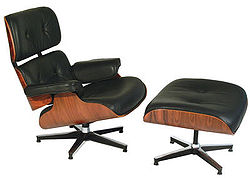
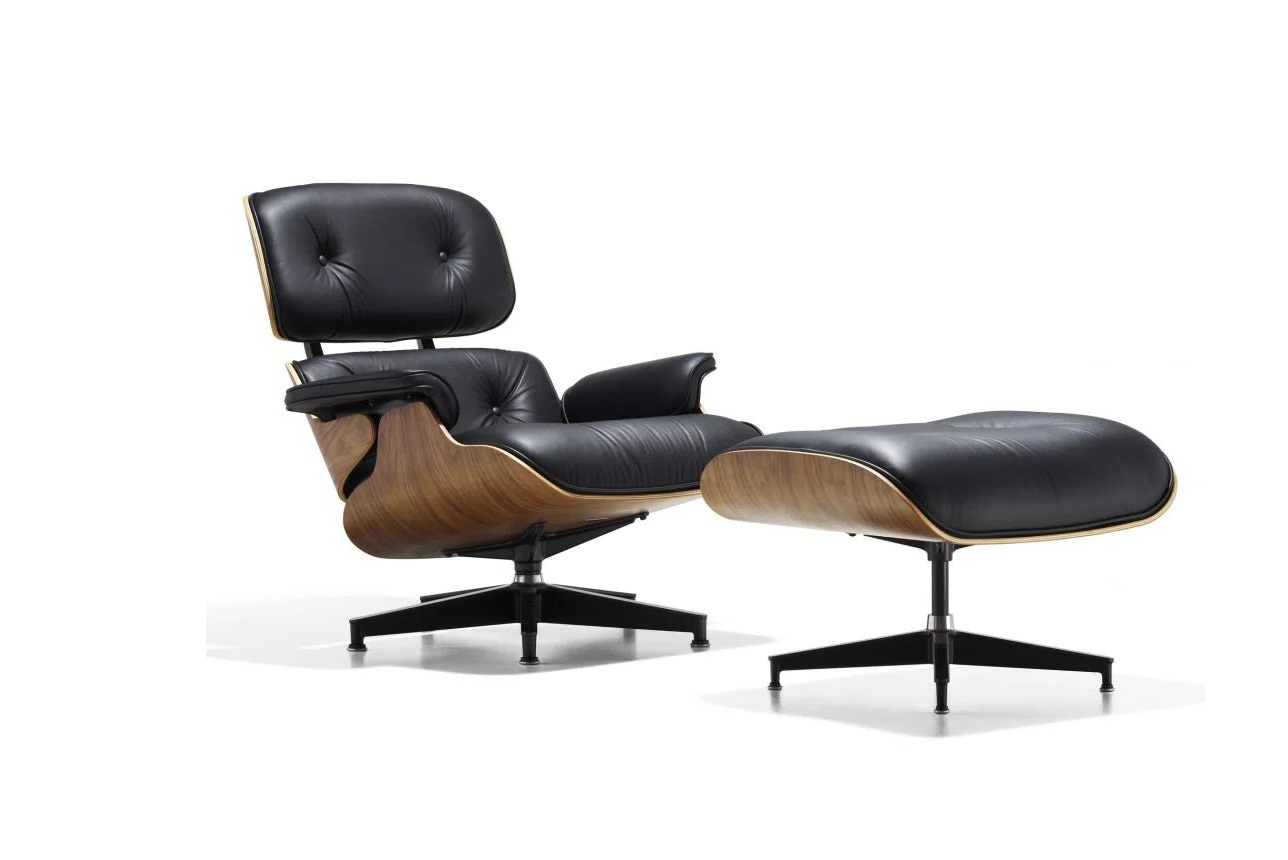
Their aim, along with several collaborators, was to make functional furniture with an attractive design that could be produced cheaply and quickly on a massive scale. Their experiments and designs proved to be successful and the Eames began to get contracts for their moulded plywood furniture that combined an organic aesthetic with technical ingenuity.  Branching out from wood, the couple also pioneered such technologies that are widely used today, such as fibreglass, plastic resin, and wire mess chairs.  Most notable is the 1956 Lounge Chair, made from leather and plywood, a design that is still quite popular in rec rooms today.

Eames Chair and Ottoman- Ikea anyone?

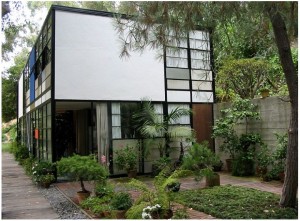
For the sake of the Eames lasting legacy in the history of modern architecture, it is necessary to mention the Eames House was constructed in 1949.  The design for this landmark structure was proposed by the husband and wife team for the famous Case Study house program for Arts and Architecture magazine. The goal of this program was to have an architect design a modern house, elaborating on its functional requirements and then actually build the home.  The house proposed by the Eames reflected their needs as a young married couple looking for a place to live, work and entertain.

They choose a site along the Pacific coast, and using mostly pre-fabricated steel and glass walls, constructed a home heavily influenced by cubist painter Mondrian’s “Composition in Red, Yellow and Blue”.

As a result, of the replacement of concrete walls for glass, the inhabitant of the home is afforded a spectacular view of the coastal property and exterior greenery, meanwhile, taking advantage of the natural light that is allowed to stream throughout the house. Of all of the proposals that were submitted for the Case Study houses, the Eames House is considered to be the most successful, as it not only made a definite architectural statement, but also functioned quite well as a comfortable and practical living space.  The property is still maintained by the Eames family, who continue to use it as an occasional residence, and it was designated a National Historic Landmark in 2006.

Eames House

So… consider this: although you might not find the Eames furniture in your hospital waiting room, rec room,or local restaurant, many mass produced models still bear their innovative legacy, either in their design, comfort or materials.  For the Silo, Eve Yantha.