All posts by The Silo

Rural Ontario Archaeology

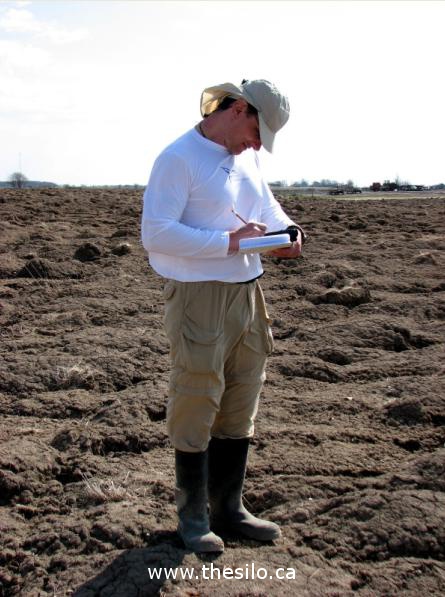
Lorenz taking notes in the field

I was raised in the dairy farming community of Jarvis in Haldimand County.  Since dairy was on the decline my family and I decided I would go to university. I began the study of archeology, and The Haldimand Norfolk Archaeological Research Project (HNARP) is a scientific study intended for my doctoral dissertation.

I selected this region because as a youth I walked across many of the county concessions and came to have an understanding of the landscape. In addition, there is continuous encroachment on the farm lands in the form of housing subdivisions in growing communities, industrial development along the lakeshore, and external landowners waiting to develop the land. The long term goal of the HNARP is to improve current evidence of prehistoric climate change and to determine its impact on early people. A study has never before been undertaken in Ontario over such a large parcel of land, and it needs to be done now before the opportunity is lost forever.

When the Laurentide ice sheet began receding 20,000 years ago the lands left behind were devastated by glaciers that destroyed plant life and any chance for animal or human survival. The first hints of people in the region date back 11,000 years. Evidence of their existence is in the form of stone debris and tools left behind on the ground. In fact,  Haldimand is the locus of our study because of the abundant chert formations in the region (chert is a type of flinty rock). These were a continuous draw for early people constantly in need of stone for tools and weapons. This same geology is the source of the quarry rock that provides jobs and careers in the community today.

Which brings us to one of the most rewarding outcomes of this kind of archeology: the people of Haldimand-Norfolk will begin to understand their relationship to the land as part of a 10,000 year history of human habitation. By systematically studying the major watersheds we can learn much of both archeological and environmental importance. Settlement patterns emerge. We begin to see how fluctuations in the climate of the Great Lakes region impacted plant and animal life, and the seasonal availability of certain foods. As we learn about the past we discover connections to the present, and can plan more effectively for the future. But the evidence we need can only exist under certain conditions, and development is not one of them. The HNARP must act now to learn what we can.

Our success depends on agricultural landowners acting as stewards, to preserve and protect archaeological sites so they can be properly interpreted and understood. People are often concerned about what an archeological study on their lands might mean. Let me alleviate some of those concerns. The HNARP regional study is conducted on private property. That means simply: your land remains your land. All information relating to this scientific study is strictly private and confidential. No information is made public or shared with any institution or public organization.  Generally, landowners can continue their farming practices without any interruption from this study.

One of the most interesting aspects of our work is something we call “community archaeology.” Interested community members can volunteer to be trained in to work with HNARP members, and become part of the discovery themselves.  For the Silo, Lorenz Bruechert.

The Brothers Bloom

The Brothers Bloom
THE BROTHERS BLOOM (2008)
D: Rian Johnson

I always get a little nervous when a movie starts with voice-over narration. Perhaps I shouldn’t– lots of good movies, especially American ones, begin with this omniscient voice. It’s arguably a lazy device, but effective if you want to pack a lot of background into a few short minutes. The Brother’s Bloom, writer/director Rian Johnson’s second major studio feature, manages to stand apart even in it’s use of this usually prosaic staple. Listen closely: the narration rhymes.

It turns out to be an appropriate opening gesture. The brothers, extremely literate con-men played by Mark Ruffalo and Adrien Brody, inhabit the modern world like glamorous anachronisms, gentlemen thieves in elegant suits who travel by steamer and luxury train. Into this consummately stylish dream falls–by no accident–Penelope Stamp, eccentric heiress and principle mark of their final job, played to perfection by Rachel Weisz.

Weisz is like heaven to watch. I can’t remember finding a woman so flawlessly beautiful for two straight hours (trust me, I’ve talked to a therapist about that irritating perfectionism). And a big part of the beauty of Penelope Stamp, apart from, or maybe as well as, her sad brown eyes and angelic countenance, is her deep intelligence, charm, whimsy and wisdom. Johnson has created a very compelling character here, and Weisz eats it up, scene after scene.

Another standout, in a movie full of standout acting, is Rinko Kikuchi as the brothers’ nearly mute and certainly odd explosives expert Bang Bang. Kikuchi has been a rising star in Japan for several years now–you can watch for her in some upcoming english-language films as well, notably Mikael Hafstrom’s Shanghai (she will take the lead in Ahn Hung Tran’s Norweigan Wood). Or just marvel at her here, as she carries on whole conversations without saying a word.

With The Brothers Bloom, Rian Johnson has assembled a stellar cast to follow his smart and very stylish lead, creating a film full of interesting, funny, even beautiful moments. Just wait until the tree falls over. I don’t think my telling you will ruin a thing. 

Widely available on DVD.

Early Canadian Artist Decorated Ceramics From Nuttal Codex

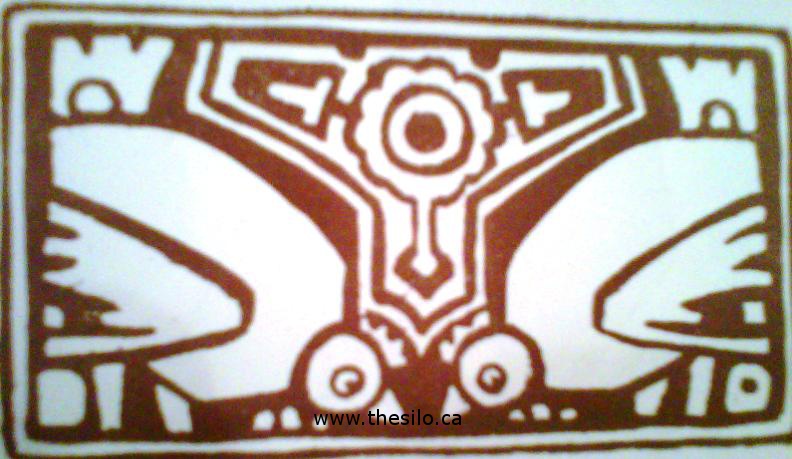
Example of Eva’s work influenced by Aztec design.

Eva Brook was born in 1867, the year of confederation and, interesting as well, the incorporation of Moosehead Beer. Auspicious beginnings. Her Simcoe family owned The Brook Woollen Mill, and like many privileged children of her time she attended private school. She was fortunate to study art under Frederick Bell Smith, the renowned Canadian-Victorian painter, at Alma College in St. Thomas. Brook would later return to Alma as a teacher, and in fact headed the art department there.

In the 1890’s Eva emigrated to Mexico, where it seems she operated a bookstore, and where she may also have re-connected with her soon-to-be husband A.W. (Will) Donly, who she had known from school. After their marriage in Norfolk, the couple returned to Mexico where Will had taken the post of Canadian Trade Commissioner.

Eva’s skill as an artist continued to develop against the backdrops of her upper-class life in a diplomatic household, as well as the unrest following the 1910 Mexican revolution (though her paintings, as shown, do not reference the violence of that time). She made friends with the archaeologist Zelia Nuttal, who had developed a system for decoding the symbols of pre-Colombian art, and the current exhibition contains ceramics Brook-Donly decorated based on the Nuttal codex, as well pieces from her collection of Aztec pottery and artifacts.

After the Donly’s return to Canada Eva embraced the emerging, modern painting style of Tom Thomson and The Group of Seven, and her work began receiving more attention. In The Review of the Royal Canadian Exhibition, an article which appeared in Canadian Forum, December 1920, she is mentioned alongside Arthur Lismur, Franklin Carmichael and A.Y. Jackson. There are some hilly landscapes in some of her work that appear to directly quote Jackson’s treatment of the same.

It may be hard to fathom now but in 1920 The Group of Seven represented a revolution in Canadian painting, rankling the sensibilities of many  established and more naturalistic artists. That Eva was attracted to their work, and understood it, suggests a progressive spirit–that is if picking up and moving to Mexico in the 1890’s was not enough for you. Any doubt will surely be erased by her decision to study with the American artist and designer Ralph Johonnot. His use of colour was vivid and idiosyncratic and his images, as one writer of the time put it, were like “illustrations for a fairy tale.” Brook Donly’s experiments with this style veritably leap out from among her other paintings as if they were sitting under a black light.

The impact of Mexico continued to feature in her art through the 20’s as well. If she picked up an interest in pattern design from Johonnot, she combined it to great effect with Aztec and Maya motifs to create striking, two-colour images for ceramics.

Eva Brook Donly was an early figure of the Simcoe establishment and one of the first members of the Norfolk Historical Society. For the Silo, Chris Dowber. 

Disaster Themed Comedy Not Funny

Dear Silo, I’m tired of jokes about the oil spill. Leno. Letterman. On June 1st  2010 John Stewart dedicated the entire “fake news” portion of his show to jokes about the spill. It’s true that much of the humour contained social and political commentary. But it wasn’t “funny.” Still, Stewart and his audience were killing themselves. Appropriate, I guess, since this issue highlights how we are all killing ourselves.

On the other hand, I like that his whole show was about this. Why is anyone talking about anything else? I know, life continues (for now). The World Cup is on. The Canadian auto sector is rebounding (perfect). Activists are crashing the Gaza blockade.

But you know what, I don’t care. Why aren’t we all parking our cars until we can convert them to run on biodiesel or excrement? Why are we watching Glee or driving to Dairy Queen or making love? Why are we not all in the streets in sackcloth and ashes, of one accord?

The world’s experts aren’t able to fix this leak, proving, as an acquaintance of mine pointed out, that there actually are no experts on how to fix deep sea oil leaks. They just know how to pump oil. And we all seem content to let them keep pumping oil for us. We shake our heads at the television footage and point fingers at negligent corporations and politicians, and then go back to pumping gas. Pumping hands. Making business deals. Making love.

In Cat’s Cradle, Kurt Vonnegut proposes that at the end of the world, when the planet is truly and fully dead, the few surviving mammals will lose their sex drive. No drive to reproduce (what for?), to survive. No drive. Now that’s funny. Alan Dowber.