The Phragmites invasion was identified as the number one concern facing the Long Point area at this summer’s Long Point Biosphere symposium on ecosystem stresses.
Phragmites growing along the Chesapeake Bay shoreline. image: chesapeakebay.net
In the pond adjacent to my house, a few Phragmites plants appeared about 20 years ago. Those few stalks then turned into a patch covering 15 per cent of the pond. It took 20 years but I’ve now eliminated it – although it has cropped up elsewhere on our farm. I realize what I’ve seen for an increase is small in comparison to what has occurred in some areas, for example, Phragmites dominates the ditches along Highway 402.
More than 10 years ago, Dr. Scott Petrie and Long Point Waterfowl were one of the first to research the expansion of Phragmites in the Long Point area. At that time, the potential threat was just beginning to be realized. Its threat wasn’t widely known outside Long Point except amongst waterfowlers and naturalists.
The last session of the legislature debated Phragmites as a part of the Invasive Species Act. This bill has currently had its second reading.
My concern as a landowner is to have the tools to deal with Phragmites. The Invasive Species Act doesn’t provide this kind of help. Ideally, the Act should contain an education plan, funding and ways to prevent spread. The Act puts an emphasis on landowners to control invasive species, but doesn’t provide the wherewithal to make it happen.
This is not to say the Invasive Species Act is all bad legislation, it’s just big on stick and small on carrot.
Now in talking about tools, we realize the challenges of controlling Phragmites. It spreads through both seeds and rhizomes and is just about impossible to control without herbicide.
I recently attended a St. Williams meeting on Phragmites, hosted by the Ontario Phragmites Working Group and Long Point Ratepayers’ Association, that focused on methods of control. Control alternatives varied from manual extraction, to discing it under, to experimentation with herbicides, to prescribed burns. Herbicides are the best alternative for large areas, but the issue is approval needs to be granted for application over water.
When Phragmites colonizes an area, it spreads quickly and prevents the new growth of other plants. It’s also poor habitat for wildlife. It impacts humans as well through loss of recreational opportunities, negative tourism impacts, decline in property values and blocked sightlines.
When Purple Loosestrife was the hot invasive plant, I was Parliamentary Assistant to the Minister of Natural Resources. In conjunction with the Ontario Federation of Anglers and Hunters, hit squads went into areas where Loosestrife was rampant and manually removed it. It’s not that simple with Phragmites, and we have yet to see this kind of commitment from government.
During the St. Williams symposium, we learned the City of Thomas has tackled Phragmites with minimal expenditure. The goal is to have the city Phragmites-free by 2020. Lambton Shores has also been aggressive and the plant is now 99 per cent under control in the municipality.
When Purple Loosestrife was first identified as an issue, it was thought to be the worst invasive plant in the province’s history – Phragmites now has that dubious honour. It will take a concerted effort by government, communities and individuals to take it on. It’s time to get serious! For the Silo, MPP Toby Barrett
This article focuses on the challenges for authors of dealing with an editor’s and reviewers’ comments within the manuscript publication process. The paper commences with an overview of the peer review process. The nature and style of comments from editors and reviewers is outlined and the inherent meaning demystified. Using a wide range of anonymised examples, sample comments are categorised according to their ease of being addressed and whether or not the author agrees with them and the need to respond highlighted. Advice is offered regarding the construction of a response document, outlining how editor and reviewer comments have been addressed in the revised manuscript and an example comprising both editor and reviewer comments and author responses provided.
The importance of this document in providing a clear audit trail of associated amendments to the manuscript and their justifications in response to the editor’s and reviewers’ comments is emphasised. Céline Rojon and Mark NK Saunders
Levallois lithic technology in the USA? The cores tell the story by Richard Doninger EDS. DISCLAIMER- We reproduce here a portion of our disclaimer from Doninger’s PCN Part1 article. Doninger’s collection is controversial and may indeed be a mix of genuine artifacts and geofacts.
One of the primary reasons to look at his material is the story he tells. It is one that the founders, members, and many readers of PCN (click here)are very familiar with. It involves a mainstream science community that is so dogmatic in its beliefs that it is willing to both block evidence or not even look at evidence that might challenge those beliefs. These beliefs include that there were no genuinely ancient people in the Americas and that early people throughout the world were less intelligent than us.
The idea that Lower, Middle, or Early Upper Paleolithic-style tools (in the European archaeology sense) are present in the Americas and mainstream resistance to the possibility is something that founding members geologist Virginia Steen-McIntyre (volcanic ash specialist), archaeologist Chris Hardaker, and geologist, the late Sam L. VanLandingham (diatomist) are/were all too familiar with as are also copy editors Tom Baldwin and David Campbell. This is not to mention the layout editor’s experience of censorship regarding evidence disproving cognitive evolution.
So, in a field where censorship of challenging evidence is routine—anthropology—virtually every proclamation the field makes needs to be questioned. One thing that we can be certain of is that once someone becomes “professional” in this field, in all likelihood, they will already be strongly opinionated regarding what is possible.
Dr. Steen-McIntyre, who started this regular feature section of PCN make it as a means to encourage avocational archaeologists and to help them raise the bar above the mere collecting of artifacts (the easy part) to adopting as many professional practices as possible especially in the recording and presenting of their finds. While Doninger’s artifacts are all surface collected, with few specific details of their discoveries recorded he does, nonetheless, present an interesting case that Levallois technology was established and varied in the southwest Indiana (c. Evansville) region.
Our publishing of Rick’s series is not an endorsement of his collection per se, but a reminder that we in the U.S. need to hold our anthropologists accountable as objective scientists, and, like in the field of astronomy, take the contributions of its amateur enthusiasts with a degree of interest.
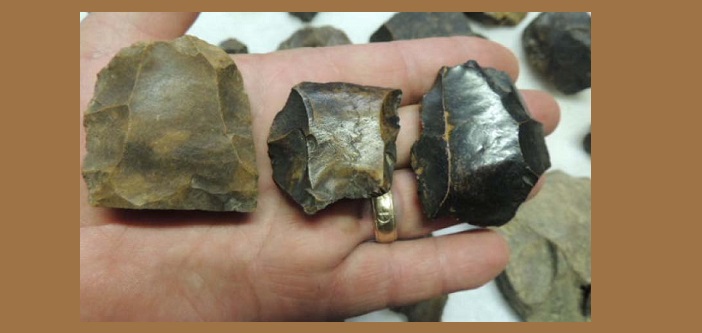
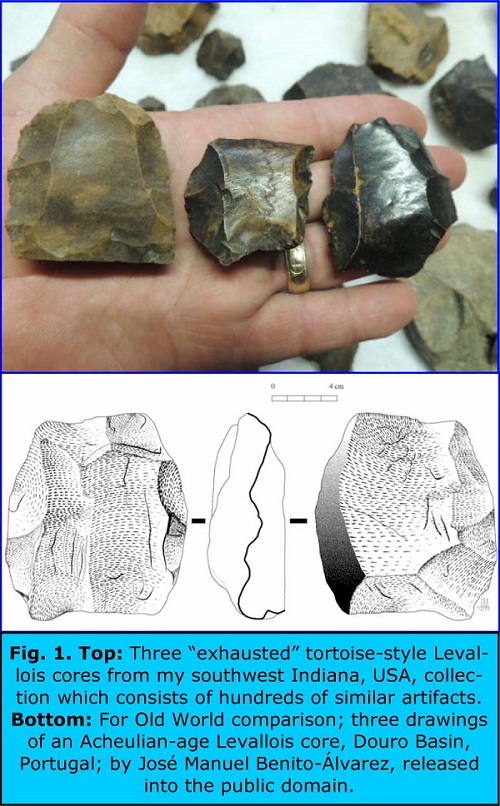
In Part 1, I shared the story of my initial experience in trying to get input from the mainstream American archaeology community regarding Levallois artifacts including cores I have found in southwest Indiana (e.g., Fig.1) They repeatedly told me that such lithic technology wasn’t present in this country. After many years of research and communication with many professionals, I came to realize a few things that I wasn’t aware of. The first thing is that just because someone is an archaeologist by profession it does not mean that they have any expertise in lithic technology from prehistoric times.
The second is that just because an archaeologist has expertise in Native American lithic technology, does not mean they have any knowledge about lithic technology of early man such as that found abroad, e.g., “Levallois.” This leads to the third and most disappointing which is that many mainstream archaeologists will pretend to know a great deal more about the subject than they actually do and, often, rather than admit that they don’t will fall into simply towing the party line and coming back with a standard mainstream answer should you offer them any kind of evidence that challenges their long held beliefs such as about our origins or how old were the “first Americans” or who might they have been.
I guess one lesson I have learned well is that PhD B.S. is still discernible as B.S. even to a window cleaner such as myself and even though the attempt to camouflage it in scholarly data is present.
After almost two decades of inquiry and research on early lithic technology it seems to me that there is still very little known by American archaeologists about what is considered late Lower or Middle Paleolithic technology such as that found in sites abroad which are “usually” associated with Neanderthal occupations. The terms “Acheulian,” “Mousterian,” or “Levallois” all seem to produce perplexed looks when mentioned in most archaeologist circles and among those who are considered experts in the area of ancient flint tools and flint knapping.
Having said all of these things, I would like to share a bit from an amateur perspective on the subject. I mentioned in my last PCN article that I was told by lithic experts abroad that the only way to identify Levallois lithic reduction was to have some of the cores from which the proposed Levallois flake tools were struck.
Levallois cores are very distinct in appearance and are rarely mistaken for later type technologies such as those blade cores from what is considered the Upper Paleolithic.
There are at least four known core preps which I have found to be considered Levallois which yield several different flake types used in producing a fairly wide variety of tools found from what is considered the late Lower and Middle Paleolithic. All of these are unmistakably different from the American Clovis and later technologies commonly found in the USA.
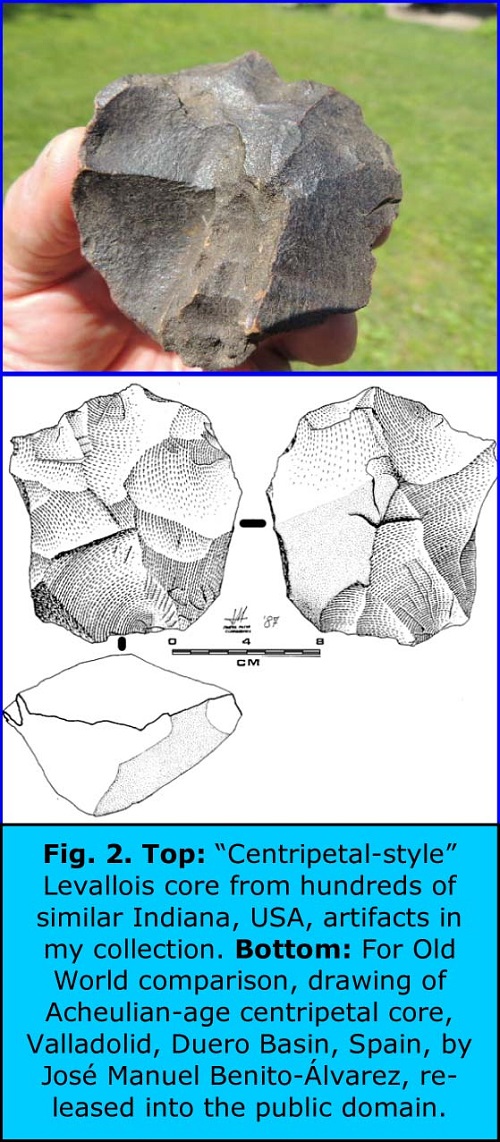
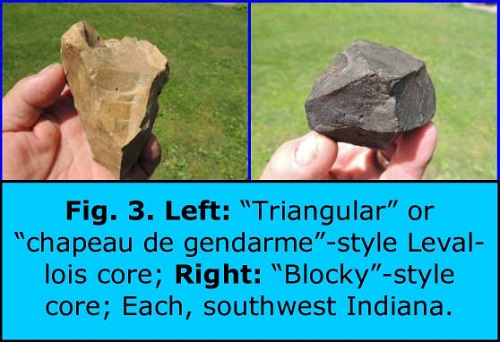
Those four include the most commonly described “tortoise” (refer to Fig. 1, above), the “centripetal or discoidal” (refer to Fig.2, above),“triangular or chapeau de gendarme,” and the “blocky” core (see Fig.3 below)- all of which yield a very specific type of tool which are similar in morphology and are mostly made on flakes rather than blades (which are the hallmark of most known Native American technologies).
When archaeologists or collectors discover lithic scatters or “debitage” left from Clovis or later archaic tool production it is very recognizable to the trained eye familiar with Native American tool industries. The same applies with Levallois technology and the debitage produced from it. It is unmistakable to the trained eye but can remain virtually invisible to the eye programmed to see Clovis and later evidence, which seems to have been the case for decades now among American archaeologists. They have been recognizing only the evidence that they have been trained to see. That can now change as there is sufficient evidence in enough quantity to recognize what has been considered late Lower and Middle Paleolithic technology all over the world and is now available for analysis here in the USA.
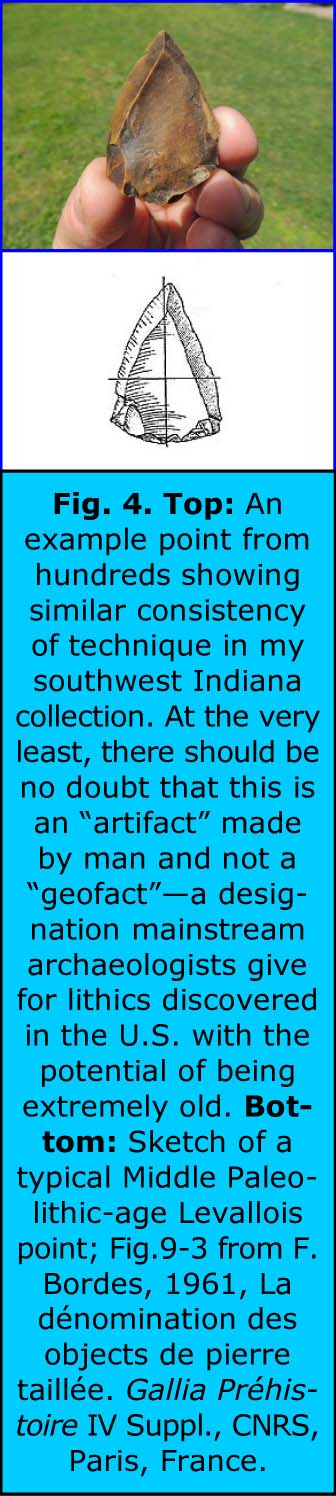
If “the cores tell the story” it can now be told because we have the cores! For this article I have included an example of each core preparation as well as an example point tool (see Fig.4 below) made on Levallois flakes from such cores. A close look at the cores will reveal the negative triangular scars from where triangular flakes were struck revealing the method of reduction.
Levallois lithic reduction has been shown to be a more productive method of tool making in general than the later blade technologies as a wider range of tools can be produced by making the tools on flakes rather than blades. Contrary to the most commonly held belief that later blade technologies such as Clovis or Solutrean were more advanced, I personally believe the Levallois reduction resulted in a much wider range of tools from the same basic core preps which leave one to conclude that it is actually more advanced and complex than those who are assumed to have come later in history.
Over the last several years I have witnessed many who claim expertise in flint knapping who are able to produce virtually every kind of Native American “arrowhead” or bifacial blade tool commonly seen within the known Clovis or later tool industries. Some talented knappers can produce a very fine Clovis point in a matter of minutes and other arrowheads present little challenge in reproduction; but rare are the ones who can reproduce Levallois tools. How the flakes are struck so systematically and consistently from the same core preparation remains a mystery to most. One simply cannot appreciate the complexity of the industry without having such an industry to observe and most American archaeologists have never seen much less handled tools from an actual Levallois assemblage.
We have in recent years witnessed various claims of alleged “pre-Clovis” tools having been found. There are the tools from Meadowcroft Rock Shelter, Buttermilk Creek, Paisley Cave, Cactus Hill, Topper and others, each producing artifacts believed by the finders to represent cultures living here prior to those which produced the famed Clovis industry.
Unlike Clovis technology which has been found in sufficient quantity to establish an identifiable industry, none of the alleged pre-Clovis artifacts have been proven to be of an identifiable technology which has been seen anywhere else in the world in contexts believed to be older than Clovis, leaving only speculation and theory in regard to an actual identifiable “industry” to accompany the claims of a “pre-Clovis” origin.
This is not the case in regard to the assemblages of Levallois artifacts such as the ones being found in as many as eight different states now. These collections clearly display a specific identifiable technology commonly found in sites around the world which are always believed to be from contexts thousands of years older than any yet recorded in the USA. The scholarly critics of “pre-Clovis” claims often use the reasoning that none of the sites have produced a “coherent set of lithic artifacts” to justify the claims.
Having seen much of the lithic evidence from the sites such as Buttermilk Creek and Meadowcroft, I can understand the reluctance to welcome such scant evidence to support the claims because of the absence of a recognizable technology.
Levallois technology is not ambiguous when it is found, regardless of the location. The name is the first indicator in the process of identification…”prepared core.” When such cores are found, identification of the “industry” can begin and an understanding of the actual “technology” becomes comprehensive.
Although I am only showing a few cores and point tools in this article, there are hundreds more in my possession to support my claims of an actual “industry” based on Levallois reduction.
As I have stated previously, I am making no claims regarding the age of these artifacts but rather the “technology” of the tools which is clearly paralleled in the later Acheulian and Middle Paleolithic Mousterian industries of the Old World.
Although the images shown are some of the basic cores and points of the industry, there are also dozens of other tool types present in our assemblages such as burins, blades, hand axes, bolas, scrapers, planes, awls, ochers and effigies. Tools made on the cores themselves are also common, displaying the life of the core and its utilization as different tools during the reduction process of extracting flakes for points, blades and other utensils.
Although considered and labeled as “primitive man” technology when found abroad to support the proposed “out of Africa” human migration theory, I disagree with such labels and assumptions in regard to this technology. Levallois reduction obviously requires both planning and skillful execution to produce such an industry in such an efficient use of available lithic material resources.
The presence of what has been called “old world” technology here in the USA clearly shows that what is being taught in regard to our origins as a nation is wrong and needs to be acknowledged by those who are promoting such error. The evidence is as solid as the rock from which it is hewn. For the Silo (from PCN Vol7 Issue3)- Richard Doninger, a surface-artifact collector living in Evansville southwest Indiana.
Eds. Comment- Rick makes a very interesting case for a lithic technology that appears to be little-known to archaeologists in the U.S. There is still the problem that the artifacts are not documented as to the exact context of each, which, unfortunately, limits the value of the specimens.
However, if the technology is as abundant as Rick’s collection suggests, we simply recommend that he “re-collect” duplicate examples from specific locations with an exacting record of what he has found and where.
Avocational archaeology is a special section of Pleistocene Coalition News started by PC founding member, Dr. Virginia Steen-McIntyre, to encourage amateur archaeologists.


 When Purple Loosestrife was the hot invasive plant, I was Parliamentary Assistant to the Minister of Natural Resources. In conjunction with the Ontario Federation of Anglers and Hunters, hit squads went into areas where Loosestrife was rampant and manually removed it. It’s not that simple with Phragmites, and we have yet to see this kind of commitment from government.