[See Comments at the end of this article for updates Ed.] “All my pension goes to pay my electricity” – constituent. With Ontario boasting the highest energy prices in North America, quite honestly I don’t know how some people get by. When people bring their electricity bills into my office, it provides a line-by-line window on just how difficult it has become to pay the bills.
Recently I met with a couple who live in a modest 790 square foot house – they heat with one electric space heater, have been wearing heavy sweaters all winter and are doing absolutely everything they can to keep costs down. But their hydro bill for January was $641.67 — $233.89 of which was delivery charge. During the meeting I was told: “All my pension goes to pay my electricity.”
Nowadays if you can’t afford your electricity, in many cases, you don’t have the option of paying interest or getting caught up later – your service is simply shut off. To have service reconnected is often hundreds of dollars. If someone can’t afford their bills in the first place how will they ever be able to pay exorbitant fees for reconnection? Apart from closing down cheap coal generation, there are many reasons why hydro has skyrocketed.
For example, the Feed-in-Tariff (FIT) Program pays out massive subsidies for wind and solar contracts to produce power we don’t need. This continues to drive up the cost of electricity which rose by 26 per cent between 2008 and 2010 – projected to rise another 46 per cent by the end of this year. The FIT Program, with its overly-generous payments, will cost taxpayers $4.4 billion more than the previous Standard Offer Program. Wind generators operate at 28 per cent capacity and their output is out of phase with electricity demand during certain times of the day.
You can’t store electricity, so we pay the U.S. and Quebec to take the surplus power off our hands. We’ve paid them $1.8 billion over the past six years. Their industries use this cheap power to compete even harder with our manufacturers, and so the downward spiral continues.
If you’re a large user, look for the words ‘Global Adjustment’ on your hydro bill. Simply put, Global Adjustment covers the spread between market price and guaranteed price paid to generators, plus the cost of paying standby natural gas plants not to produce electricity, as well as paying for conservation programs. One North Bay manufacturer had a Global Adjustment — nonexistent on their 2009 hydro bills — of $1,700 on their electricity charge of $1,400 for that month. The Global Adjustment is expected to increase tenfold, from $700 million in 2006 to $8.1 billion in 2014. This will certainly cause more Ontario manufacturers to close up shop and move to cheaper locales.
Also, watch for the Smart Meter charges to hit home. The computer system cost $250 million, and the bill is now due.
Let’s not forget the cancellation of the Oakville power plant and cancelling, demolishing and relocating the Mississauga power plant. These cancellations were nothing more than political ‘seat savers’ for the last election and will cost taxpayers $1.1 billion.
In many ways the Green Energy Act put the desires of the renewable power industry ahead of the needs of people and Ontario businesses – a perfect formula for killing jobs and crippling consumers. For the Silo, MPP Toby Barrett
DID YOU KNOW?- Norfolk Power (and in fact all Ontario Municipal power companies to the best of our knowledge-CP) has a 13 days past due policy for Service Termination Proceedings. Even small “ma and pa” businesses provide 30 day terms and even 60-90day terms before sending out Collection Letters or Warning Letters. We contacted Norfolk Power and were told that “it’s standard policy- set by Ontario’s Energy Board”. Hmmm- that sounded like a standard “sub-standard” explanation to us, so a bit of research showed that the Ontario Energy Board is a self-regulated, internally filled board that sounds impartial but is anything but- in fact we were unable to determine exactly who or how board positions are filled, never a good sign for impartiality. If you decide to call them at 416 481 1967 be ready for one of the most confusing answering services you will ever find. Messages prompt you with a never ending supply of websites and telephone numbers- finally if you are persistent enough you will be asked to “press 9” to consent for your personal information to be gathered, recorded and used by the Ontario Energy Board- not exactly consumer friendly. I suppose you could always speak with one of the Public Information Officer but then they will refer you to media relations. You won’t be transferred (we were told they aren’t allowed to) so keep a document open and handy- 416 544 5171 and then the process begins again only this time you are immediately connected with an answering machine asking for your credentials. *sigh Fifteen minutes later from when we started our initial inquiry we realized we might as well be prospecting for dare we say it “oil”. [Update- Many Municipal aka “County” Hydro companies including Norfolk Power have sold their electricity services to Hydro One but have held onto their Water services. Ontarians will now receive a separate bill for Water and a separate bill for electricity. Perhaps more confusing, in Spring of 2015 Ontario announced that it would sell 15% of its Hydro One holdings in an IPO plan that will eventually sell off another 45% in order to raise money for debt repayment, transportation and infrastructure programs. Targeted buyers would be Canada’s largest pension plans. http://www.bloomberg.com/news/articles/2015-04-16/ontario-to-sell-15-of-hydro-one-one-of-biggest-ipos Ed. ]
If you have the brain power – take a look at this excerpt from the Energy Board’s website- listing (in broad terms) changes to Ontario’s energy act- which ultimately affects consumers in Ontario and their payment and use of energy:
|
1907-1959 |
|---|
| The Natural Gas and Oil Wells Act marked the Province’s early concern for the proper management of its energy resources – a concern that evolved through the Natural Gas Act of 1918, the Natural Gas Conservation Act of 1921 and the Ontario Fuel Board Act of 1954. |
|
1960-1998 |
| The Ontario Energy Board Act, 1960 created the Ontario Energy Board (OEB) as a successor to the Ontario Fuel Board. The OEB was authorized to set just and reasonable rates for the sale and storage of gas and to make orders granting leave to construct pipelines for the transmission of oil or gas to expropriate land for oil or gas pipes.The Ontario Energy Act, 1964 clarified certain powers of the OEB and strengthened the sections dealing with gas storage. An amendment to this Act in 1965 set out the ground rules for the OEB in determining the rate base of gas utilities and giving the OEB power to make regulations prescribing a uniform system of accounts for gas companies.On June 7, 1973, the Premier announced the establishment of the Ministry of Energy which would include the OEB. Further amendments were made to the Ontario Energy Board Act which included provisions for the appointment of additional board members and making the OEB responsible for annual reviews of rate and rate-related matters of Ontario Hydro.In the late 1960s and early 1970s, the oil crisis developed in the Middle East, causing natural gas prices to soar. Ontario Hydro turned to nuclear generation and the public became conservation conscious. During that time, the Board decided on hundreds of natural gas applications and conducted major reviews of Ontario Hydro rates. |
|
1998 |
| The mandate of the Board changed significantly with the passage of the Energy Competition Act, 1998 (ECA) The ultimate goal of the ECA was the creation of a competitive market in the electricity and natural gas industries.To achieve the goal of creating a competitive market in the electricity industry, the former Ontario Hydro monopoly was replaced by several business entities including two distinct commercial companies, Ontario Power Generation (OPG) and Hydro One Inc., and one Crown corporation, the Independent Electricity Market Operator, now known as the Independent Electricity System Operator (IESO). OPG has taken responsibility for the generation of electricity while Hydro One owns and maintains transmission and distribution wires. The IESO manages the province’s electricity system and operates the wholesale electricity market. The OEB had varying degrees of regulatory authority over all three corporations as well as the province’s municipal electric utilities.The OEB became responsible for regulating local distribution companies and for ensuring that the distribution companies fulfill their obligations to connect and serve their customers. The OEB also became responsible for licensing certain participants in the market. The OEB regulated all market participants in the province’s natural gas and electricity industries and it provided advice on energy matters referred to it by the Minister of Energy and/or the Minister of Natural Resources. |
|
2002 |
| On May 1, 2002, Ontario’s new electricity market opened. The new market was the culmination of over five years of work by the electricity industry, government, the OEB, the IESO and many other market participants. The generation of electricity became a competitive activity, with electricity bought and sold on the new spot market at competitive prices. The IESO successfully began operating the wholesale market.Over the summer of 2002, record-high temperatures drove up the demand for electricity as well as the market price, which resulted in considerable consumer concern. In response, the government introduced the Electricity Pricing, Conservation and Supply Act, 2002. This legislation, which received Royal Assent on December 9, 2002, capped the price of electricity at 4.3 cents per kilowatt hour for residential, small-business and other designated low-volume consumers, effective May 1, 2002 to May 1, 2006. This legislation also provided refunds, retroactive to May 1, 2002, to compensate those consumers for any costs in excess of the 4.3-cent cap.All transmission and distribution rates were frozen at existing levels until at least May 1, 2006. Utilities were required to receive written approval from the Minister of Energy before any application for rate changes could be submitted to the OEB. This legislation also deemed any interim rate order to be final. In addition, the new legislation modified the OEB’s objectives in the areas of energy efficiency and conservation with respect to both natural gas and electricity from “facilitating” to “promoting.” |
|
2003 |
| Proclaimed on August 1, 2003, the Ontario Energy Board Consumer Protection and Governance Act, 2003, established the new OEB as a self-financing crown corporation and gave the OEB the opportunity to do its work more efficiently and effectively. In particular, the legislation provided for a management committee to manage the activities of the OEB. The legislation further enhanced the OEB’s role in protecting and educating energy consumers.In December 2003, the government introduced the Ontario Energy Board Amendment Act (Electricity Pricing), 2003, which put in place a new interim electricity pricing structure, replacing the 4.3 cent per kilowatt hour (kWh) price cap as of April 1, 2004. Under the interim structure, residential, low-volume and other designated consumers paid 4.7 cents per kWh for the first 750 kWh consumed per month, and 5.5 cents per kWh for consumption above that level.The Act called on the OEB to develop a new electricity pricing mechanism. It also charged the OEB with the responsibility to protect and renew Ontario’s electricity grid by ensuring reasonable charges for the delivery of electricity.The legislation also required the OEB to allow local distribution companies to recoup costs (called “regulatory assets”), the recovery of which had been put on hold in 2002 by the Electricity Pricing, Conservation and Supply Act, 2002. These recoveries would be spread over a four-year period so that they would have only a modest impact on the final price to consumers. |
|
2004 |
| In June 2004, the Government of Ontario proposed a restructuring of the province’s electricity sector in order to encourage new electricity supply, energy conservation and stable prices at a level reflecting the true cost of electricity.The Electricity Restructuring Act, 2004, received Royal Assent on December 9, 2004. The new legislation amended the Ontario Energy Board Act, 1998, and the Electricity Act, 1998.The OEB became responsible for developing a transparent mechanism for establishing electricity commodity prices for eligible consumers who have not signed contracts with electricity retailers. The Regulated Price Plan, which took effect May 1, 2005, replaced the interim two-tier pricing of 4.7 cents per kilowatt hour (¢/kWh) and 5.5 ¢/kWh hour that had been in place since April 2004.The OEB also assumed responsibility for the Market Surveillance Panel, previously the responsibility of the IESO.A new agency, the Ontario Power Authority (OPA), was established to ensure an adequate, reliable and secure supply of electricity in Ontario for the medium and long term. The OEB was given the duty of approving the OPA’s fees and its integrated power system plan and procurement process. The OEB is also responsible for licensing the OPA. |
|
2009 |
The Green Energy and Green Economy Act, 2009 received Royal Assent on May 14, 2009. Among other things, the legislation amended the Ontario Energy Board Act, 1998 and the Electricity Act, 1998. It established important responsibilities for the OEB and other entities in achieving the objectives of conservation, promotion of renewable generation, and technological innovation through the smart grid.The OEB’s three new objectives are:
The OEB has an important role to play in ensuring the government’s objectives in the legislation are achieved. That includes ensuring that electricity distributors meet the requirements for renewable generation connection, smart grid implementation and conservation and demand management. |
|
2010 |
| In 2010, Ontario passed the Energy Consumer Protection Act, that would ensure Ontarians have the information they need about electricity contracts and bills, as well as the comfort of knowing they can rely on fair business practices. The new rules come into effect in January 2011. |
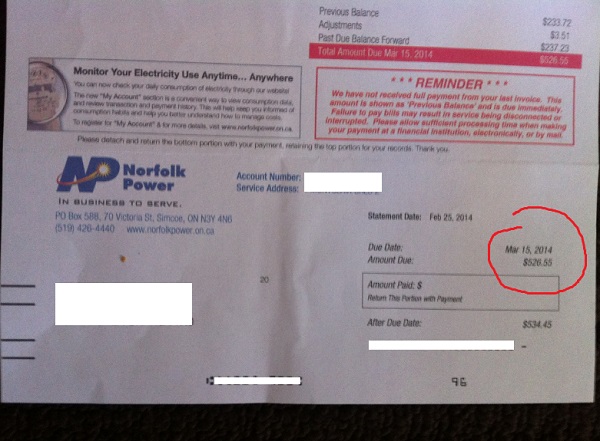
Silo reader “Jack” sent us this scan of his hydro bill- over 500$ for two months of service for a small 2 Bedroom basement apartment. Notice that he was unable to pay his bill on time due to the fact that his bill accounted for almost 50% of his rent.
View Comments (22)
This is more practical information than I've found anywhere else.
UPDATE___
How Ontario helps keep energy costs low for families, small businesses and farmers
PORT DOVER - The Ontario government is helping to keep the cost of energy low for families, small businesses and farmers by keeping electricity rates stable and providing customers with more choice and energy assistance programs.
Customers eligible for the Ontario Electricity Rebate (OER) will automatically receive a
33.2% reduction off their energy bill when new electricity rates for Regulated Price Plan (RPP) customers come into effect November 1, 2020.
At the same time, customers paying Time-of-Use (TOU) rates under the RPP will also have the option to switch to tiered rate pricing. Time-of-use electricity rates vary by time of day and are comprised of three different rate periods of off-peak, mid-peak and on-peak pricing. Tiered electricity rates provide customers with a set rate for electricity up to a certain level of consumption.
"As we recover from COVID-19, our government remains focused on supporting Ontarians by keeping the cost of electricity affordable," said Greg Rickford, Minister of Energy, Northern Development and Mines. "We are proud to offer the people of Ontario more options and the flexibility to choose between TOU and tiered pricing."
“This flexibility is important to allow both Ontarians who work during the day and those who are home during a day an option that works better for them,” said Haldimand-Norfolk MPP Toby Barrett. “I have been hearing for years from seniors that TOU doesn’t work for them. At the same time, it does work for working families. Now people have a choice.”
The province has also revised the eligibility requirements for the COVID-19 Energy Assistance Program (CEAP) and the COVID-19 Energy Assistance Program for Small Business (CEAP-SB). Households, small businesses and charitable organizations who made partial payments on amounts owing before the COVID-19 emergency period are now eligible for the CEAP and CEAP-SBone-time on-bill credit to help pay down electricity bill debt. The expanded eligibility also eliminates the requirement for residential consumers to be unemployed when applying for CEAP. Local utilities will re-assess previously rejected applications and start accepting new applications on October 16, 2020.
Ontario is also introducing a new streamlined Energy Affordability Program (EAP) for households struggling to pay their electricity bills. Beginning the week of January 4, 2021, EAP will:
* Provide free electricity saving measures to help participating households
manage their electricity-use and lower their electricity costs by up to $1,000 per
year;
* Tailor energy-efficiency upgrades based on household income, home heating
system, location, and an energy needs assessment; and,
* Simplify access to new and updated electricity saving measures through a
single program that replaces the Affordability Fund Trust and Home Assistance
Program, which are ending in 2020.
The Energy Affordability Program is part of Ontario's new 2021-2024 electricity Conservation Demand Management (CDM) Framework, which also offers energy-efficiency programs for on-reserve First Nations consumers and Ontario business and industrial consumers to increase competitiveness and lower electricity costs. The new Framework will come into force January 1, 2021, immediately following the end of the current Interim Framework on December 31, 2020.
"Our government continues to look for ways to support Ontarians in need," said Bill Walker, Associate Minister of Energy. "The initiatives announced today will help ensure Ontario families and businesses can manage their electricity bills, while keeping our energy system strong and reliable."
The province will also introduce on-bill messaging in 2021 that will explain Ontario's rate mitigation programs and how customers are benefiting from Hydro One earnings. A part of this will keep energy rate increases to no more than two per cent.
________________________________
Quick Facts
* On October 9, the Ontario government announced additional public health
measures
in Toronto, Ottawa and Peel Region and will make available $300 million to assist
significantly affected businesses with fixed costs, including property taxes,
hydro and natural gas bills.
* The Ontario Energy Board (OEB) sets both time-of-use and tiered rates as part
of the Regulated Price Plan
(RPP). RPP rates are
updated twice a year, in May and November. Today the OEBreported the new
rates
coming into effect on November 1, 2020.
* Multi-use complex consumers that are currently receiving the OER under
grandfathering provisions will now continue to receive the rebate until April 30,
2021. The grandfathering period was previously slated to end on October 31, 2020.
* Residential consumers must apply to CEAP, and small businesses and charitable
organizations must apply to CEAP for Small Business (CEAP-SB) through their local
electricity and/or natural gas utility.
* The 2021-24 CDM Framework governs the Independent Electricity System
Operator's (IESO) Save on Energy
businesses, institutional customers, income-eligible residential customers and
on-reserve First Nations communities. Save on Energy programs provide
energy-efficiency opportunities and support Ontario families and businesses
looking to make upgrades to lower electricity costs.
* The Energy Affordability Program (EAP) will provide differing levels of
support based on income eligibility. Participants could receive a free
professional energy assessment and installation of in-home electricity savings
measures or an energy savings kit.
* For on-reserve First Nations communities, programs under the CDM Interim
Framework that were suspended due to COVID-19 will be relaunched, to allow time
for projects to be completed. Ontario's First Nations communities will be engaged
in Fall 2020 to inform the development of new programs that will build on the
success of previous programs.
________________________________
Additional Resources
* Learn more about time-of-use (TOU) and tiered rate
pricing
* Find out about additional ways to reduce your electricity
bill
* Visit the Save on Energy
about CDM programs under the Interim Framework and the new CDM Framework as more
information becomes available.
* Visit the Independent Electricity System Operator's (IESO) website to learn
more about EAP, the 2019-2020 Interim Framework and the 2021-2024 Framework when
more information becomes available.
* More information on CEAP is available from the Ontario Energy Board.
A vision and a plan for what Ontario could be
Our government came into office a year and a half ago having presented a vision for Ontario – and the people of this province bought in.
People bought into a vision of an economy that is open for business, and open for jobs for those who want to work.
It is a vision of safe communities, strong health and social services, and accountable government.
A vision for Ontario that requires government to get out of the way when not needed while getting the major things right: economic fundamentals, sound public policy that reflects the priorities of people, and common sense.
When you get the fundamentals right, you set the stage for success. You create a vision of what could be … and then map out a detailed plan of how to get there.
You think beyond the barriers and challenges of today and consider the better future that could be… And then to do the hard work of developing and executing the detailed plans to make that vision real.
In contrast to what was going on before, we are asking people to imagine the possibilities – to imagine what could be accomplished.
Imagine public hospitals across Ontario where service levels are high and wait times are low.
Imagine a housing market where homeownership isn’t just a dream, but a reality.
Enough job-ready graduates – particularly in the skilled trades - who match the needs of a growing economy, energized by a world-leading public education system.
And imagine an economy that empowers our entrepreneurs and innovators to take risks in Ontario, creating jobs in communities across the province.
This can be our future. An Ontario where each person, and every family, has an opportunity to succeed.
We have everything we need to take on the world whether it be in steel, or auto, or agribusiness - and win.
As Ontario’s Finance Minister reiterated in a recent speech to the Canadian Club of Toronto, we are in a highly-competitive global economy, where companies and countries do everything they can to defend their advantages.
We live in a world where other states and provinces work hard to compete, leveraging their advantages and their local strengths for the benefit of their citizens.
When we look around the world we see countries that get it. Countries that want to win. They are hungry and determined to create innovative and globally-competitive economies for the benefit of their citizens.
In this global competition for talent and investment and innovation, our province has underperformed.
Our government understands that this is the reality for our country and our province and we have to up our game.
We must have a government focused on improving our competitiveness and productivity - without that focus we all get poorer. Because there is a necessary link between a growing economy, and our ability to invest in world-class government services and supports for all of us and particularly for those most in need.
We believe the role of government is to enable the opportunity for a better quality of life, and a higher standard of living, for all of our citizens. All of this is within the context of that increasingly competitive global economy.
That is why we have a plan, and that is why we’re implementing that plan.
Toby Barrett MPP for Haldimand-Norfolk
Speaking in favor of fixing Ontario’s ‘Hydro Mess’
QUEEN’S PARK – I spoke in favor of the expected $442 million in savings to the cost of electricity that will be realized through the Fixing the Hydro Mess Act. I rose twice during debate of Bill 87 in the Ontario Legislature. We came in, in the past election, where Ontario had the highest, fastest-rising electricity costs in North America, and we were sitting at the highest rates in Canada.
Highlighting the goal of the legislation to make electricity affordable, I focused on the part of the legislation that addresses conservation programs. Overall, the goal is to reduce costs and reduce duplication, to streamline. We still have a patchwork of what I consider inefficient electricity conservation programs. A lot of them just aren’t cutting it.
The goal is to reduce duplication by refocusing and centralizing electricity programs.
We’ll leave those programs in that are most effective and provide the most benefit, but so many of them will be gone if they’re not necessary.
Toby Barrett MPP Haldimand-Norfolk
For more information, contact MPP Toby Barrett at 519-428-0446 or toby.barrett@pc.ola.org
ONTARIO LEGISLATIVE ASSEMBLY
DRAFT HANSARD
Monday, April 8
Mr. Toby Barrett: I do appreciate the opportunity to comment on what is an ongoing issue with the cost of electricity. I think most of us here, in door-knocking over the last two or three elections—really, what we heard at the door was that people were having difficulty paying their bills, and specifically their electricity bills. So I’m quite heartened that we are now debating yet another piece of legislation to clean up the hydro mess. I get a kick out of the title of Bill 87, the Fixing the Hydro Mess Act.
Full disclosure: I heat with electricity. That means, out of necessity and given the ongoing high price of electricity, I go through, this winter, maybe 15 cords of wood, and in a colder winter, perhaps 20 cords of wood. It’s good exercise. But I’m in an area where there’s no natural gas and I have to rely on electricity for heat and just about everything else.
When we were in opposition, we made a number of commitments to help out with the price of electricity. Part of that was to—we talked about a rebate to return the cost of conservation programs to the electricity ratepayer and have it funded through general revenue. It’s one more step in a series of ongoing steps, and I’m sure there will be more to deal with this.
We came in, in the past election, where Ontario had the highest, fastest-rising electricity costs in North America, and we were sitting at the highest rates in Canada. So I fully appreciate this kind of legislation and I look forward to many more actions on this front.
Mr. Toby Barrett: Let’s go back to the speech from the member from Burlington. I feel she did an excellent job in explaining how critically important fixing this hydro mess really is, on behalf of families who work so hard and businesses that are doing their best to try to create jobs and boost our economy.
The member summarized a number of points. Obviously, our goal is to keep electricity affordable and to improve transparency. We have a program to reduce costs by centralizing and refocusing conservation programs. We’ll leave those programs in that are most effective and provide the most benefit, but so many of them will be gone if they’re not necessary. Our goal is to build a modern, efficient and effective energy regulator for all of us.
Speaker, taken together—we’ve heard this in the House today—our plan is looking at savings of up to $442 million.
We are planning on making the regulatory changes to the Ontario Energy Board to make it more efficient, to make it more accountable, and to hold electricity bills to the rate of inflation—that’s our commitment—and to save billions of dollars in borrowing costs that previously had been tied to the Liberals’ failed Fair Hydro Plan. We also have to replace that failure with a new and very transparent rebate to those of us who use electricity.
Overall, the goal is to reduce costs and reduce duplication, to streamline. We still have a patchwork of what I consider inefficient electricity conservation programs. A lot of them just aren’t cutting it.
Barrett back to Queen’s Park
QUEEN’S PARK—MPP Toby Barrett, Haldimand-Norfolk, is back to work at Queen’s Park to make sure the Power Workers’ Union does not strike. Yesterday's resumption of the Legislature is about ensuring that people across Ontario have a stable power supply over the holidays and into the winter months.
“This is an emergency. I’m back to Queen’s Park to help ensure that the lights stay on and Ontarians stay warm and safe,” said MPP Barrett. “Allowing the NDP-supported shut down of our nuclear and hydro facilities would place people at risk—especially seniors, critical care patients, and nursing home residents. Not taking action could be catastrophic.”
Ontarians need and deserve a reliable power supply—especially during the winter. In the event of a strike, the province would be without a stable, safe supply of power. Small businesses, hospitals, and senior’s homes could see rolling black outs. And many families would be without a safe power supply to heat their homes. That is a risk the government cannot take.
The Ontario government respects the collective bargaining process and would rather the two sides reached a deal to provide an uninterrupted power supply to Ontarians. The hope is that the NDP caucus will realize the urgency of the situation and help pass the legislation quickly.
For more information, contact MPP Toby Barrett at 519-428-0446, 905-765-8413, 1-800-903-8629 or toby.barrett@pc.ola.org Please mention The Silo when contacting.
Cleaning up Hydro One is an urgent priority
By MPP Toby Barrett
One reason we spent this summer at Queen’s Park – the House rose mid-August – was to bring in legislation to begin to clean up the hydro mess.
Case in point – I just wrote a cheque for a property that used $23.05 of electricity, but required $40 to deliver it.
Residential electricity costs increased 71 per cent between 2008 and 2016, more than double the national average increase of 34 per cent.
Meanwhile, the CEO at Hydro One made $6.2 million last year, not to mention the lofty $14.2 million other top executives paid themselves at our expense.
This summer Greg Rickford, Minister of Energy, Northern Development and Indigenous Affairs shepherded the passage of the Urgent Priorities Act.
As he explained during debate, nowhere has the public’s trust been so tested as with our province’s electricity system. We’ve heard it on the doorstep time and time again. We’ve heard it at town halls. We’ve read it in every community newspaper. The public’s faith in the management of this province’s electricity system has fallen and fallen. In recent years, they have been given little reason to hope that things would change.
Premier Ford agrees, “It is morally indefensible, at a time when seniors are fearful of heating their own homes, when businesses are closing down and good jobs are moving out of our province, and when taxpayers are facing financial hardships – all due to skyrocketing hydro bills – that this board and this CEO were laughing themselves to the bank.”
Under the previous government, Hydro One executive compensation reached unprecedented levels. The CEO of Hydro One was given $6.2 million in 2017. About $3.5 million of that was in the form of stock-based incentives. We can’t change that but we have been able to find a negotiated solution at Hydro One that would help minimize the costs to Ontario ratepayers.
On July 11th, we were pleased to accept a proposal from the board of directors of Hydro One that will see the board step down and be replaced as of yesterday-August 15th.
By engaging constructively with Hydro One’s board, we have delivered on our commitment, our promise to the people of Ontario. We have kept the company stable and we have achieved a lower-cost result by avoiding substantial severance payments.
Hydro One is an important company and a vital part of our province’s electricity system. It controls 95 per cent of the transmission wires that cross Ontario. It is also the local distributor for over five million customers. It has far more rural and remote customers than any other distributor in the province. These customers are often the most vulnerable, the people struggling the hardest to make ends meet.
To successfully operate a company like Hydro One, you need a great deal of technical and financial knowledge. As important as that knowledge may be, the other imperative is an understanding and respect for the customer. Providing certainty and direction for the company and reassurance to the public that their interests are protected can be a win for all of Ontario.
Fortunately, the days of choosing between heating and eating will be drawing to close as our continued work will save the average Ontario family 12 per cent on their hydro bills – about $170 a year.
Toby Barrett MPP for Haldimand-Norfolk
Out of control electricity costs cannot go on
For years [read article above], I have been railing against the high cost of electricity – full disclosure, I heat with hydro which means I go through 10 to 20 cords of wood a winter. Ontario now has the fastest-rising electricity costs in North America, and the highest rates in Canada. This cannot go on.
We as Opposition have proposed measures to lower the average hydro bill an additional 12 per cent on top off the existing 25 per cent reduction.
The annual Hydro One dividend should be rebated to ratepayers instead of using the $350 million a year for government projects. Conservation programs are worthwhile but they should be funded from general revenues.
Under the Green Energy Act, Feed-in Tariff (FIT) contracts have led to exorbitant subsidies for generating power that is simply not needed or could have been generated in other less expensive ways. We must use every legal and feasible opportunity to renegotiate or exit contracts at every contract breach, whether it be missed operational deadlines or permit violations.
Where feasible, we must walk away from committed capacity contracts that have cancellation benefits, like pre-notice to proceed contracts that were struck under the Green Energy Act, thus avoiding already scheduled rate increases.
The Smart Meter Charge is intended to pay for the province’s data centre, although the Auditor General has found that 812,000 of the 4.8 million homes with smart meters have not transmitted any data. This smart meter charge – at $1 billion over budget -- should come off immediately.
Ontario ratepayers are now paying for a CEO who makes over $4 million a year. That’s six times what the old CEO at Hydro One used to make. We must reign in exorbitant executive salaries at both Hydro One and OPG.
The CD Howe Institute charges Green Energy Act policies have “had a dramatic impact on electricity costs in the province, but they have generated very limited environmental benefits and have had a negligible-to-negative effect on economic growth and employment.” As we’ve been saying since its inception, it’s time to repeal the Green Energy Act.
Green energy is a good thing, but paying unaffordable rates for power we don’t need, and forcing projects on unwilling host municipalities is wrong. As we have said many times in Opposition, we will restore local planning authority over wind and solar and force government to present the environmental impact of their decisions.
Energy planning decisions in Ontario are made by political staff instead of by the energy experts at the Independent Electricity System Operator (IESO). Any future long-term energy plans must be brought before a legislative committee to be studied in depth, in public, and with the Minister of Energy and the expert staff at IESO and other core agencies required to give advice or explain their decisions.
Ontario’s IESO must be required to report on potential options – rooted in evidence – to reduce the amount of hydroelectric power the province wastes annually.
The Ontario Energy Board must be reformed to reduce red tape, drive costs out of the system, and create a flexible regulatory body.
We should proceed with nuclear refurbishment in Ontario and keep Pickering Nuclear Generating Station open until 2024.
Fourteen years of mismanagement, recklessness, and politically-driven decisions have left families, seniors and business owners paying more. This cannot go on.
Toby Barrett, MPP for Haldimand-Norfolk.
Deal or No Deal? – Facts Still Matter in Ontario
The Conservatives, including their leader Patrick Brown, were quick to jump on a single misinformed and mistaken story from La Presse this morning about a proposed electricity agreement deal with Quebec.
They quickly fanned out to media outlets across the province to spread misinformation, including Patrick Brown visiting AM640, and Energy Critic Todd Smith appearing in the Queen’s Park media studio.
Unfortunately, Brown and his colleagues are again completely mistaken, as the proposed agreement deal with Quebec had already been rejected by our government. Luckily for us, we know that Facts Still Matter in Ontario.
Brown claimed: “Boy is this a horrible deal for Ontario”
Fact: The “deal” doesn’t exist. The La Presse story is actually talking about an indicative offer from Hydro Quebec to Ontario. In our government’s response, we rejected the proposal. That response is already public.
In fact, earlier today in the Queen’s Park media studio, his own PC Energy Critic contradicted him:
“No I believe the fact is that minister Thibeault hasn't signed off on this deal.”
Source: MPP Todd Smith, August 8, 2017, Queen’s Park Media Studio
Source: attached correspondence from Minister Thibeault.
Brown claimed: “Last year we spilled enough power in Ontario …to power 500,000 homes.”
Fact: We’ve seen this claim from the Conservatives before, and it just demonstrates their lack of understanding of the energy system. One advantage of the clean, reliable, and flexible system we have built is that we are able to procure energy on an as needed basis, using only the electricity that can be produced most cheaply at that time. This is key – any time a generator is not producing electricity, it is because there were cheaper options available at that time. Apparently, the Conservatives think we should be running these generators anyway.
Source: http://www.ieso.ca/power-data
Smith claimed: “Kathleen Wynne and Glenn Thibeault need to categorically reject this deal. They need to show the people of Durham that they meant it when they said time and time again that they support the Pickering Nuclear Plant.”
Fact: Once again, the deal as it was reported was already rejected. And when it comes to Pickering, it was our government that made the commitment to continue operations at the Pickering Nuclear Generating Station to 2024. Nuclear is a reliable source of clean, around-the clock power, and it helped get our province off of coal. OPG is already in the process of seeking regulatory approvals, and we continue to support that work.
Source: http://www.opg.com/generating-power/nuclear/stations/pickering-nuclear/Documents/P-CORR-00531-04930.pdf
Patrick Brown Discredited by his Own Energy Critic - AGAIN
MPP Todd Smith admits Conservative policy might not be out until 2018
"Oops, he did it again."
As predicted, Conservative MPP Todd Smith couldn’t make it through this morning’s press conference without contradicting his leader Patrick Brown. This time, Smith admitted that Ontarians may not see any policy ideas from the PC Party until as late as 2018.
Here’s a brief timeline showcasing Brown’s energy plan flip flops:
Almost four months ago, Brown first promised to release his own hydro plan “in the near future.”
In a CHML interview on March 2nd, Brown first revealed the PC party would announce their plan “in the coming weeks.”
The following day, he told the Barrie Examiner his hydro announcement would be coming “very shortly.”
Then, on March 9th, Brown told reporters after his Toronto Region Board of Trade speech that he’d outline his plan “in the near future.”
Yet now Ontarians are being told they could be kept in the dark until 2018.
When questioned by the media on the new timeline, MPP Smith claimed his leader “has been consistent” when questioned about finally releasing policy.
The truth is he’s been anything but.
While Patrick Brown continues to dodge and weave on the energy file, Ontario Liberals have brought forward a plan that is lowering rates 25% on average for families, with rate increases also being held to inflation for the next four years. By providing real, long-lasting relief, our Fair Hydro Plan makes sense for Ontarians.
For More Information: (416) 325-9138 Please mention The Silo when contacting.
Facts Still Matter in Ontario – March 3, 2017
Good afternoon,
Patrick Brown was on CFRB 1010 this morning trying to attack our plan to lower electricity bills by 25% on average for all residential customers. Instead he was criticized for not having a credible proposal of his own.
Michael Taube, a former Harper speech writer and close friend of Brown’s, called the performance “an unmitigated disaster” and that Brown “didn’t sound like a leader.”
Even Conservative supporters calling in weren’t impressed:
Caller: “I was surprised you were giving this person so much time because they didn’t know what they were talking about.”
Caller: “Patrick Brown should have been prepared. He sounded like a young politician.”
Caller:” Please don’t let this be Patrick Brown…Please don’t let this be Patrick Brown.”
They understand that Facts Still Matter in Ontario. Take a listen to their comments here:http://www.iheartradio.ca/newstalk-1010/audio (March 3 free for all round 1 @ 6:40)
Twitters users also expressed their distaste:
He claimed: “if we sell a majority [of Hydro One] we’re going to lose future control over rate increases.”
Fact: This is their biggest proposal yet it’s completely false – it won’t take one cent off electricity bills. Energy rates will continue to be set by the independent Ontario Energy Board, who has a mandate to protect ratepayers.
(Source: http://www.ontarioenergyboard.ca/OEB/Industry/Regulatory+Proceedings/Applications+Before+the+Board)
Others agree:
“This idea that because it's private rates will go up is a straw man…They'll still have to go to OEB, still have to go through the same rigmarole whether it's public or private. If it's private, people might even push against rate hikes more."
Brady Yauch, former Energy Probe economist and current economist at the Consumer Policy Institute, CBC, April 20th, 2015
“Your hydro costs won't change with new ownership. Hydro One is and will remain a regulated utility that answers to the Ontario Energy Board (OEB).”
Jack Gibbons, Chair, Clean Air Alliance, NOW Magazine, April 29th, 2015
“In Ontario, though, the OEB, or Ontario Energy Board, sets the rates, and utilities must make their case whenever they want to raise prices.”
Tim Kiladze, Globe and Mail, September 29th, 2016
He claimed: “She won’t share them [contracts] with the public, we only have a copy of one of the contracts which is completely wrong. The opposition should have access to these contracts but the one contract we have a copy of the Samsung deal.”
Fact: Template contracts - all over 100 pages - for the FIT program rounds 1 to 5 are publicly posted. Brown has had almost 2 years as Leader of the PCs to provide his opinion on ‘ripping up’ these contracts, but instead has decided to spread misinformation. (Source: http://fit.powerauthority.on.ca/program-resources/program-archives/version-1)
He claimed: “you know there would be really, there would be significant opportunity to, to get rid of the surplus just in the, just in the bad deals.”
Fact: PC Energy Critic Todd Smith admitted earlier this week that renegotiating contracts would come at a huge cost to taxpayers and would cause electricity prices to rise. (Source: [4:38] http://www.iheartradio.ca/580-cfra/shows/news-views-with-rob-snow-1.1867979)
Experts agree:
“I think they’d find themselves in court for years and years to come. It sends a terrible message to the market that they can’t rely on government to enter into a binding agreement. They get sued and it can end up costing the taxpayer an awful lot of money.”
Paul Harricks, Energy, Infrastructure and Mining Industry Group Lead, Gowlings WLG
“The costs of ripping up Ontario’s renewable energy contracts would be staggering.”
Ron Clark, Energy Law at Aird & Berlis LPP, teaches Energy and Infrastructure Law at Osgoode Hall
He claimed: “I actually put up on twitter yesterday the list of the companies that made donations and the contracts they got.”
Fact: He didn’t. (Source: https://twitter.com/brownbarrie)
He claimed: “so FIT-5 is today.”
Fact: Today is the deadline for participants to withdraw their application to FIT 5, no new contracts are being signed today. This is very, very clear on the IESO’s website. (Source: http://fit.powerauthority.on.ca/what-feed-tariff-program)
He claimed: “We give away electricity at a loss to Pennsylvania, Michigan, Ohio, New York.”
Fact: We’ve seen this one from Patrick Brown before. The last time the provincial Conservatives were in power, they spent $900 million importing electricity over two years just to keep the lights on. Given our position of strength, Ontario is a net exporter now, benefitting ratepayers to the tune of $230 million in 2015 (as estimated by the Independent Electricity System Operator).